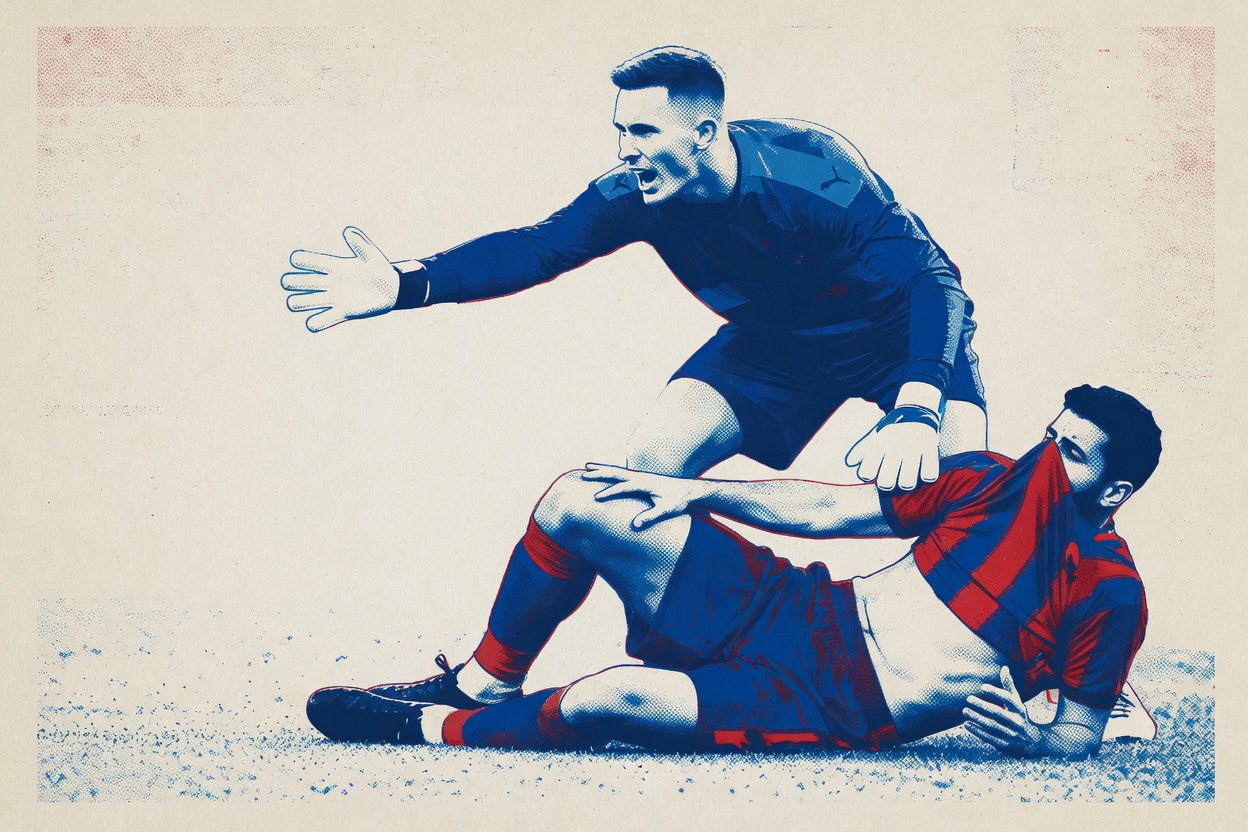
There are injuries you watch and wince at, and there are injuries you watch and feel a knot form in your stomach because you've seen this exact scene before. Chadi Riad going down at Hill Dickinson Stadium on August 22 — by one account appearing to twist his left knee as he tried to deal with a cross from Vitaliy Mykolenko, by another going down attempting to block a Thierno Barry shot — was the second kind. Dean Henderson didn't wait. He immediately waved for the medics. Riad pulled his shirt over his head and was in tears as he was stretchered off to warm applause, replaced by Takehiro Tomiyasu in the 72nd minute of a 2-0 defeat. Palace's social channels posted "We're right behind you, Chadi." You didn't need a caption to understand what the club was bracing for.
What we actually know, and what we don't, matters here. So far, Palace hasn't confirmed a diagnosis. Reports have used careful, hedged language: he "appeared to suffer another serious knee injury." That word, another, is doing a lot of work, and it's why this column exists. None of this needs a confirmed scan to matter. The pattern alone is already on the record.
The pattern is not in dispute
Riad joined Palace for around £14m and has spent an alarming share of his time there in a treatment room rather than on a pitch. A knee injury picked up after his home debut against West Ham at the start of the 2024/25 season, from a Carabao Cup win over Norwich, kept him out for months. Shortly after returning, he suffered a cruciate ligament problem in training that meant another long spell out. Those two injuries alone cost him a combined 430 days. That's not bad luck, that's most of two seasons.
So when a defender with that history is on the floor in tears on the opening weekend, the honest reaction is suspicion, not just sympathy. Something about the way this player's career keeps stalling deserves harder scrutiny than a supportive tweet.
The comeback that made this hurt more
What gives the story its cruelty is how good the recent chapter had been. Riad fought back from that rehab to start and keep a clean sheet in Palace's UEFA Conference League final win in Leipzig, part of a trophy run under Oliver Glasner that also brought the 2025 FA Cup and the Community Shield. Then he went to the World Cup and belonged there. He completed 90 minutes as Morocco beat Haiti 4-2 in Atlanta, played a part in a decisive goal by meeting a corner before Soufiane Rahimi finished, and was in Morocco's starting XI for the quarterfinal they lost 2-0 to France on July 9, Kylian Mbappé scoring and setting up Ousmane Dembélé. For a man who'd lost 430 days, that was a genuine triumph.
This is where the column moves from reporting to opinion, because no official, medic, or pundit has said what I'm about to say. Riad went from long-term ACL-type rehabilitation, to a full World Cup campaign in June and July, to Palace's Premier League opener on August 22, with barely six weeks in between. For a knee that had already failed twice, that's a punishing amount of load compressed into a tiny window, with almost no genuine off-season to absorb it.
The uncomfortable question
Nobody has proven that workload caused this. It's entirely possible this is a freak twist, the kind of thing that happens to healthy knees on any given Saturday. Palace hasn't commented on load management, and an inference from a timeline isn't the same as a confirmed causal link.
But it's fair to ask. When a player with two serious knee injuries in his file is asked to run a World Cup and then start a top-flight season within six weeks, someone, somewhere, should be able to explain the plan. Was there a plan to protect that knee, or did the demands of club and country simply stack on top of each other until the joint gave way again? You have to wonder whether his body ever got the recovery time it clearly needed. A club that has just won trophies and spent real money on this defender owes him a sports-science operation that treats his knee as the delicate asset it obviously is.
This lands at an awkward moment for Palace. Pierre Sage, who arrived from RC Lens in June on a three-year deal to replace Glasner, was making his competitive debut in charge. His side was already without Ismaila Sarr, and goals either side of half-time from Kiernan Dewsbury-Hall and Thierno Barry sealed the defeat. Losing Riad on top of it turned a rough afternoon into a potentially season-shaping one.
Until the scan results are in, any verdict on Palace's culpability stays provisional. If this turns out to be minor, I'll happily file the concern away. But the pattern was already there before this weekend, and a supportive message won't answer the question it raises. This is a player whose body keeps breaking down after long layoffs, and it's fair to ask whether the people responsible for managing that body are asking too much of it, too soon.