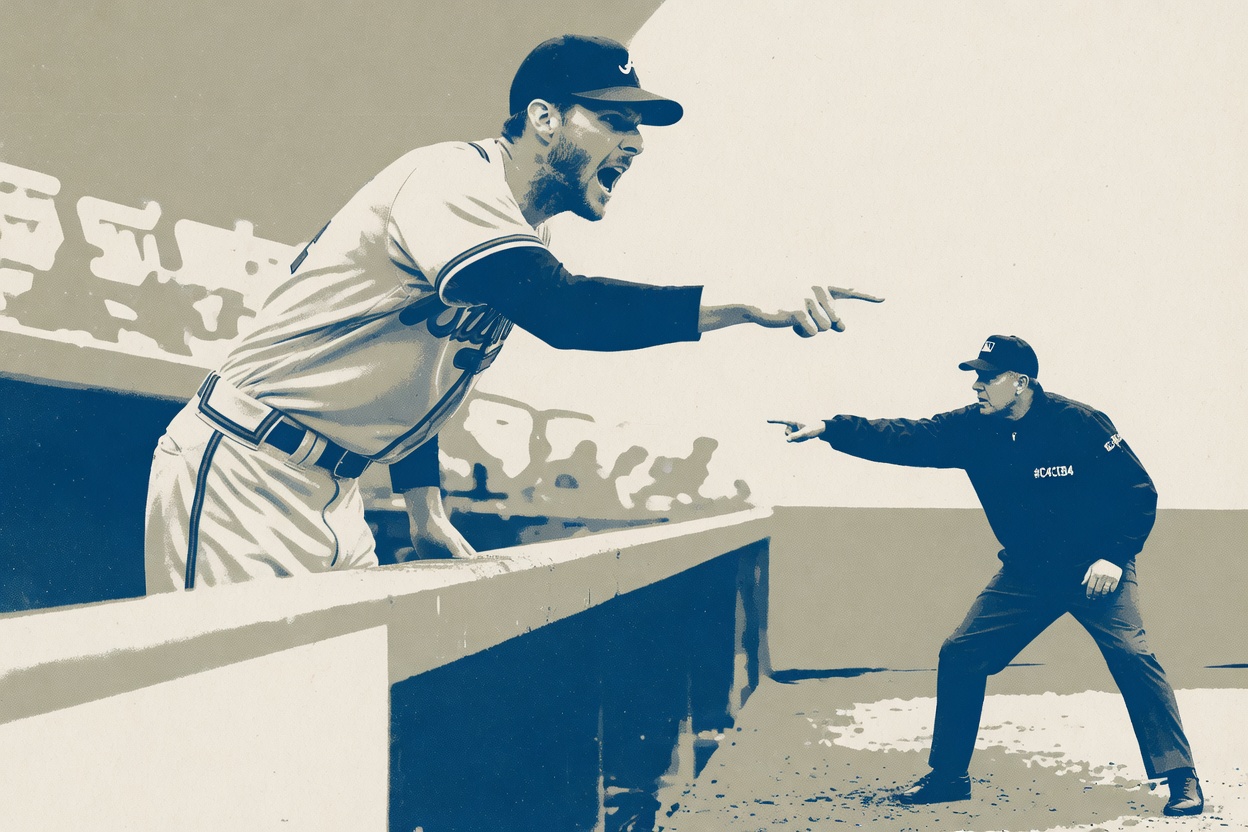
On Saturday night at Yankee Stadium, a game turned on a rule so rarely enforced that the crew chief had to stand in front of a reporter afterward and walk everyone through what it even was. That's not a functioning rule. That's a trap.
Fifth inning, score tied 2-2. Spencer Jones is on third after his RBI triple, Austin Wells is at the plate. Chris Sale starts his motion, and home-plate umpire Dan Merzel calls a balk. Jones trots home. A tie game becomes a 3-2 Yankees lead. Sale then gives up a double to Wells and walks Paul Goldschmidt before escaping, and New York wins 5-4. Sale, who came into the weekend at 12-7 with a 2.20 ERA over 21 starts in his third season with Atlanta, took his first loss since June 28.
Why the balk? Not because Sale did anything a fan could see as cheating. Crew chief Dan Bellino explained it afterward: Sale is a "hybrid pitcher," meaning you can't tell from his setup whether he's working from the windup or the stretch, so he's required to declare which one he's using. He'd declared the windup when he struck out Jose Caballero. He didn't declare again before facing Wells. Bellino's words: "It needs to be very clear. It's not something that we can assume."
My problem with that, and it's an opinion: if the whole point of the rule is that the umpire can't assume what a hybrid pitcher is doing, the burden shouldn't fall entirely on the guy on the mound to remember to announce himself before every at-bat. Flip it around. Make the umpire ask. A simple, proactive check: "Windup or stretch here?" That's the fix. Instead the current setup lets a pitcher who's done the same thing his entire career get nailed for the omission at the worst possible moment, in a tie game, on the road, with a runner ninety feet away.
This isn't some fluke only Sale could trip over. The same rule got Tampa Bay's Matt Andriese back in 2017 and Boston's Nick Pivetta in 2023, both charged with balks for failing to declare from a hybrid setup. Nearly a decade of the same seldom-enforced footnote producing the same bewildered arguments. When a rule keeps ambushing different pitchers across different teams and years, the rule is the problem, not the pitchers.
Walt Weiss saw it that way immediately. Atlanta's manager argued for several minutes and got tossed, his first ejection as the Braves' skipper. Afterward he was blunt: "Sale declared the hitter before that he was going out of the windup. He said he did not declare after that. He's never done that in his career so it's a terrible call."
Bellino's rule, as written, isn't crazy on paper. He was careful to note it doesn't apply to everyone: "Your traditional pitcher that pitches from the traditional windup and traditional stretch do not have to make the declaration." Fine. But technically correct and good for the game aren't the same thing, and this weekend is exhibit A for why.
It didn't end Saturday. It festered. On Sunday, before a single pitch of the series finale, as the umpiring crew walked toward the plate past the Braves' dugout, Sale, who wasn't even scheduled to pitch, started barking at Merzel about the night before. Merzel stepped back, pointed, and ran him. Weiss got drawn back in and was ejected again, two days running. Per Elias, it was Sale's fourth career ejection and the first in a game he didn't pitch, his first ejection since August 2019 with Boston.
A run-scoring balk on an arcane technicality on Saturday spiraled into a pitcher getting thrown out of a game he had no part in on Sunday. Center fielder Michael Harris II summed up how strange it was: "The game was about to start, and I saw the umpires walking up and doing their motion to throw [Sale] out. A lot of people didn't know that it happened. Nothing particularly happens before a game."
Weiss, to his credit, took the temperature down afterward: "[Sale] had some words for the umpire from yesterday. Everyone had their say, and we moved on." The Braves did move on, winning the finale 2-1 in ten innings on a Harris single. Atlanta split the damage, and as of Aug. 9 they still led the NL East by the largest division margin in the majors. The standings didn't crater.
But don't let the happy ending launder the lesson. The result was fine. The process was ugly. A rule that exists specifically because umpires "can't assume" a pitcher's intent should require umpires to simply ask. Put the ten-second question in the mechanic, before the pitch, every time a hybrid guy is on the mound. Nobody loses a run. Nobody spends two days yelling across a foul line. The drama stays where it belongs, in the at-bat.
So far, MLB hasn't announced any discipline for Sale or Weiss. That's beside the point. The fine, if it comes, isn't the story. The story is that baseball let a rulebook asterisk decide a fifth inning, then chase a future first-ballot arm off the field before the anthem. Fix the enforcement, and none of it happens.