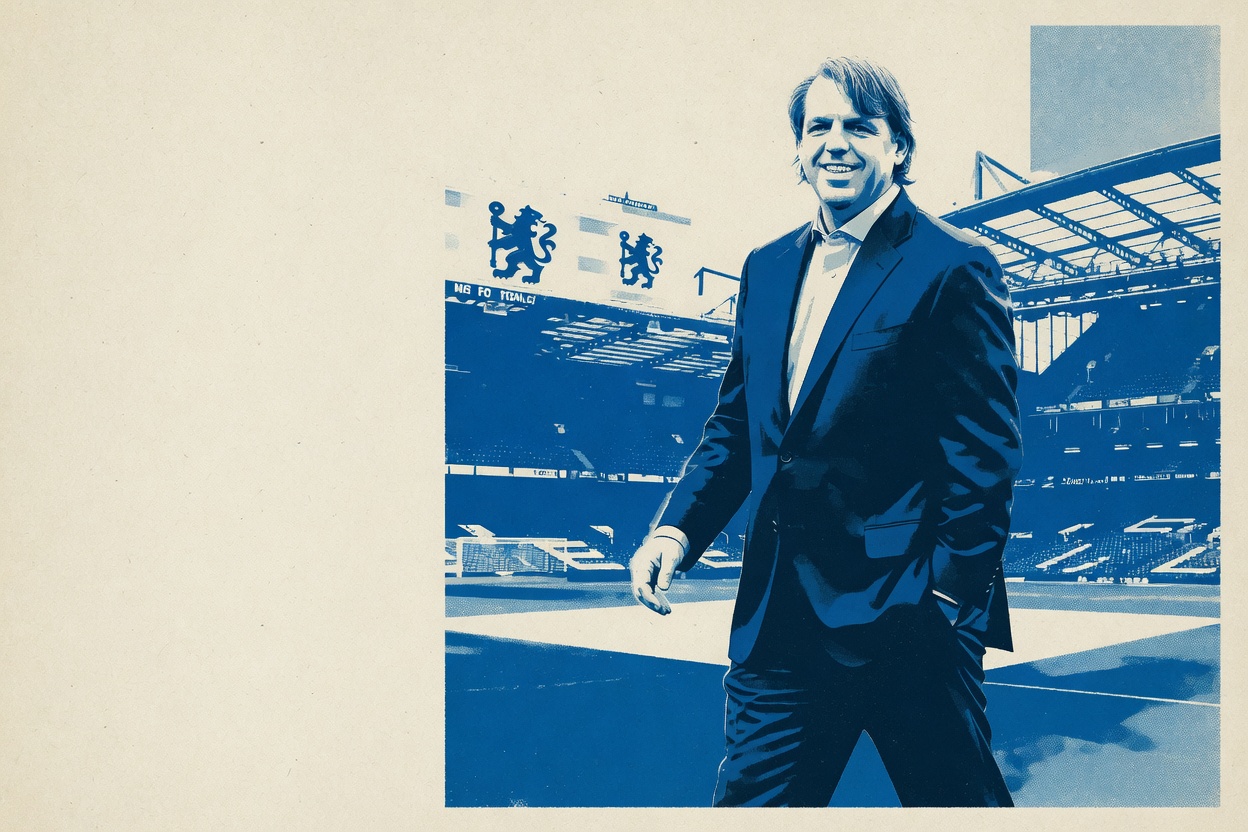
Ownership fights usually end with a press release insisting nothing has changed. Chelsea's was no different. When Clearlake Capital bought out Todd Boehly and Mark Walter this week, the club said there'd be no changes to day-to-day operations, leadership or overall strategy at Stamford Bridge. Set that against the real news, that the co-controlling structure running the club since 2022 is gone, and it reads like corporate spin. The governance changed completely: a partnership became a single owner.
The real question is whether one man in charge is good news for Chelsea, or the scariest development yet.
Start with the optimistic case, because it's real. Boehly and Behdad Eghbali weren't aligned, whatever both sides said in public. The restructuring follows years of disagreement over the club's direction, and the central wedge was Stamford Bridge. Back in March 2025, Boehly warned the owners could eventually separate if they couldn't agree on a stadium plan. He told Bloomberg the club had "a big stadium development opportunity" and that this was "going to be where we're either aligned, or we ultimat[ely part ways]." The Telegraph called it a "civil war." The split ran deeper than bricks and mortar: Boehly reportedly held a 20-to-30-year vision, while Clearlake treats the investment as a decade-plus commitment. There were tensions over football matters too, including Boehly's unhappiness at parting with Mauricio Pochettino in May 2024.
When two people at the top pull in opposite directions, decisions get slow and incoherent. Removing that friction could genuinely make big calls simpler. If the transfer chaos flowed partly from a boardroom that couldn't agree on what Chelsea even was, then centralizing authority under Eghbali, who's reportedly been the most influential figure in the group for years anyway, is a way to finally pick a lane.
Now the worry: that same friction was the only internal check. Look at what this joint ownership produced. Chelsea have signed 40 players and moved on or released 38 more, tearing up football's norms with seven-, eight- and nine-year contracts. The turnover has been called unprecedented at the elite level. Roman Abramovich's 19-year tenure never went two straight seasons without a trophy; the Boehly-Clearlake era, for all its spending, was still waiting on a first Premier League trophy, with Enzo Maresca the fourth permanent manager tasked with delivering one. Maresca did win the Conference League and the Club World Cup before leaving at the start of 2026, then Chelsea finished tenth and missed Europe entirely. The months in between were a mess: Liam Rosenior appointed in January, sacked by April, Calum McFarlane holding the fort until Xabi Alonso took over on July 1, 2026. Alonso inherited what's been called the most bloated squad the Premier League has ever seen.
That's my problem with the "stability now" narrative. All that churn happened while Eghbali was already the dominant voice. If the erratic decision-making came from a divided board, fine, one owner fixes it. But if it came from the instincts of the men who are staying, then the man who just consolidated power is the one whose calls produced the chaos in the first place, and now nobody in the room can tell him no. He isn't untested like a rookie so much as untested as a final decision-maker with no partner left to slow him down.
None of this has actually solved anything yet. The stadium question, the planning issues, Chelsea Pitch Owners, the enormous cost of any build: all of it remains open. Boehly and Walter have exited fully, selling their Ligue 1 stake in Strasbourg too, and Hansjorg Wyss stays on as a minority partner. The deal reportedly values the stake buyout at around £950m against an implied £5bn valuation for a club the consortium bought for £2.3bn from Abramovich in 2022. Boehly called it an "honour" and said he was "confident that Chelsea is well positioned for continued success under Clearlake's leadership." The polite exit line always sounds like that.
My call: consolidation removes a genuine obstacle, and Alonso's Chelsea, sitting mid-table in the opening weeks of the season, badly needs someone to set a clear direction and hold it. But clarity only helps if the person holding the wheel steers well. We're about to find out whether the chaos was the structure or the man. There is no longer anyone left to blame it on.