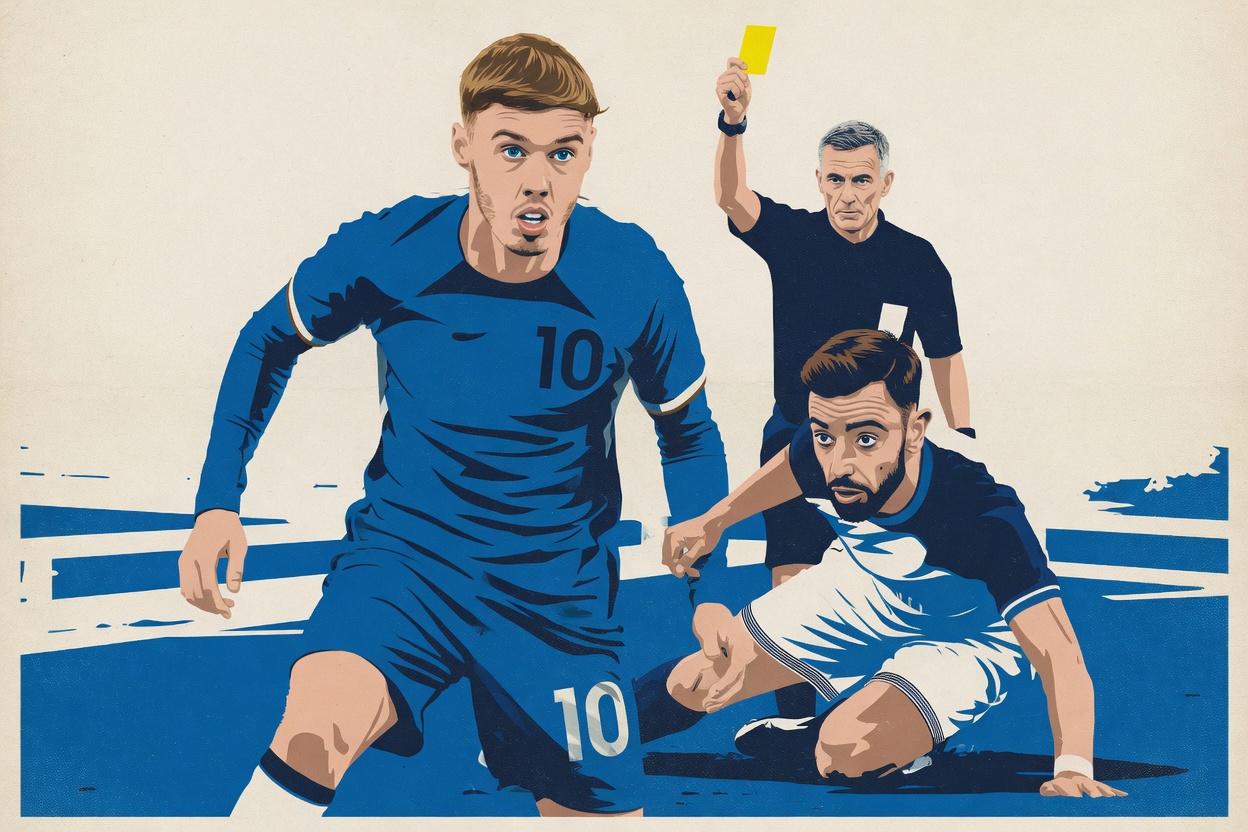
Cole Palmer should have walked in the 71st minute at Stamford Bridge. VAR looked at it and let it go. The incident was checked and cleared; the system built to catch exactly this kind of thing decided a player driving into a prone opponent's head was worth nothing more than a caution.

⚡ Upset:Tottenham had a 25% chance before kickoff and beat Chelsea 2–0.
 49%

Bruno Fernandes stopped Palmer's run with a deliberate handball, killing a Chelsea counterattack. Palmer went after him. Fernandes was down on his knees when Palmer barged into his head and got away with a yellow. The replay made the obvious conclusion hard to avoid: on another day that's a red, with contact around Fernandes' head, even if Fernandes' reaction didn't help his case.
Chris Kavanagh made the call in real time, and you can give a referee the benefit of the doubt in the moment. John Brooks, on VAR, doesn't get that excuse. He had the replay, the angles, and all the time in the world, plus a season's worth of precedent sitting right in front of him.


The Premier League has spent this entire autumn sending players off for precisely this kind of off-the-ball aggression. Three weeks earlier, Rodrigo Bentancur was given a straight red against Manchester United, and the league's own Key Match Incidents panel went out of its way to back it: "The on-field red card decision was supported. The actions of Bentancur meet the threshold for violent conduct." A week before the Chelsea game, Brentford's Yehor Yarmoliuk was sent off against Liverpool and the VAR review called it textbook. Go back to September and VAR confirmed the red for violent conduct by Phil Foden in the Manchester derby as correct. Three violent-conduct dismissals upheld on review in six weeks. Then Palmer barges into a kneeling man's head and the standard disappears.
I'm not alone in that read. Gary Neville's verdict was flat: "I think that could be a red. If this wasn't at Stamford Bridge, I think it's a red." Keith Hackett, the former PGMOL chief, said Palmer should have been shown a straight red for off-the-ball violent conduct and added, "I am disappointed that when Chris Kavanagh showed Palmer a yellow card, there was no action taken by VAR."
The defense, such as it is, comes from former referee Mark Halsey, who argued Palmer's aggressive attitude only warranted a yellow. He's grading attitude. The real question is whether a player puts his body into an opponent's head while that man is on the floor, and that's the test everyone else has been held to this season.
This comes down to consistency, and consistency is exactly where VAR failed here. Brooks declined to send Kavanagh to the monitor for an offense his own colleagues had flagged, reviewed and upheld three times in the weeks before. You can't red-card Bentancur, Yarmoliuk and Foden and then find a reason to leave Palmer on the pitch. Either violent conduct is violent conduct, or it depends on who's wearing the shirt and where the game's being played.
Chelsea's night came apart regardless. Palmer picked up a second, uncontested yellow for a reckless challenge on Conor Gallagher in the 80th minute and was correctly sent off, the first red card of his senior career. Mike Penders punched a corner into his own net, Mathys Tel added a second, and Tottenham left Stamford Bridge with a 2-0 win. But the 71st-minute non-call still mattered. It handed Palmer nine minutes he shouldn't have had, and it fed the same old idea that officiating bends around this Chelsea side. The dismissal was the club's 100th Premier League red card, with only Everton and Arsenal reaching that mark before them, and they've been sent off more than any other side in 2025-26. Chelsea has a pattern of players coached to play right up to the line, and on Saturday one of them went past it without paying for it.
There's a wrinkle that makes it worse. Palmer's automatic one-match ban falls in the EFL Cup, so he stays available for Chelsea's next league game. There's no confirmed retrospective review of the 71st-minute barge, the kind the league happily convened for Bentancur. The incident that most deserved a second look is the one nobody's reviewing.
Palmer should have gone off in the 71st minute for violent conduct. He stayed on because VAR refused to apply the standard it enforced on Bentancur, Yarmoliuk and Foden to Chelsea's best player. John Brooks looked at the evidence and chose to look away.