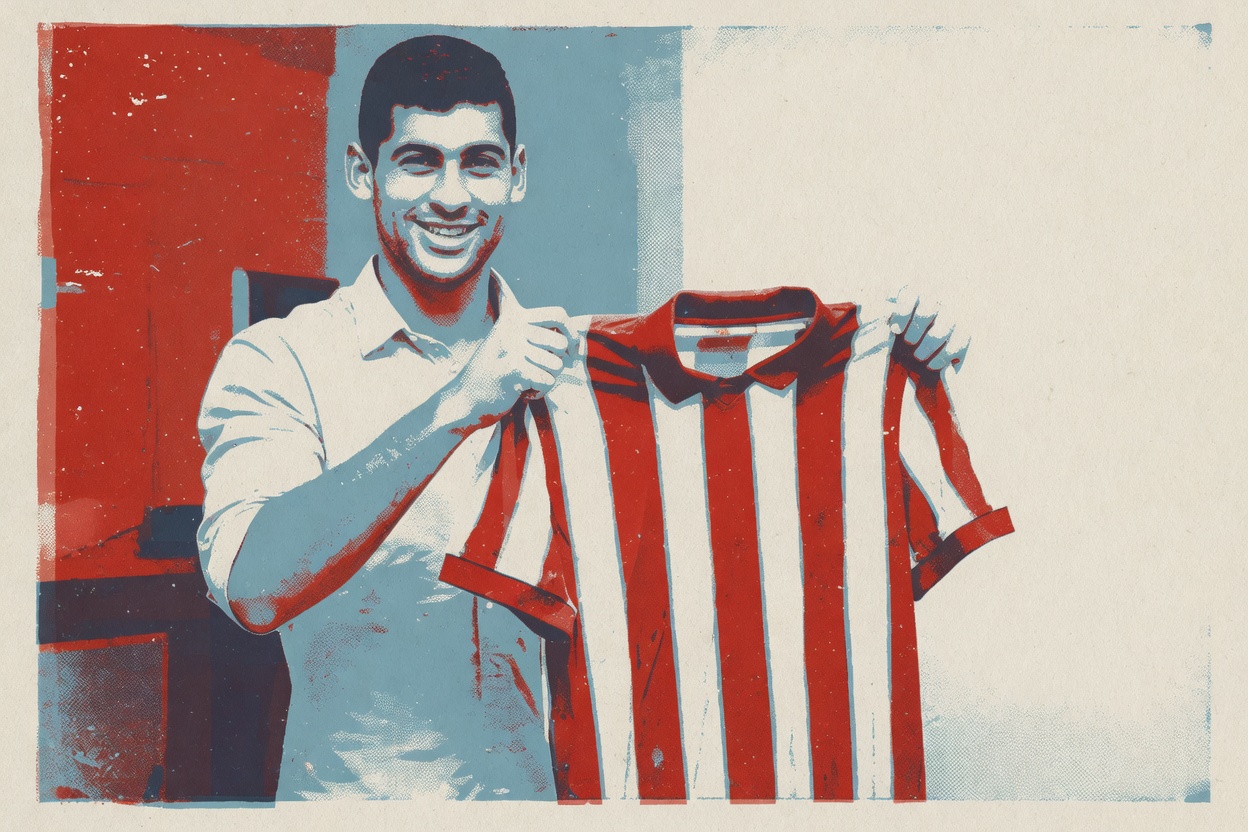
There's a version of Cristian Romero's Tottenham career that ends with a statue conversation. He was club captain when Spurs ended a 17-year wait for a trophy, beating Manchester United in the 2024-25 Europa League final in Bilbao, and across roughly five seasons and around 150 appearances he was the defender the whole backline got built around. Heroes usually get a guard of honour on the way out, not a medical at a clinic in Madrid.
Instead, on August 15, 2026, Atlético Madrid confirmed Romero had signed through 2031, a five-year deal worth somewhere around €40m (roughly £34m). Sky Sports reported Spurs kept a 15 per cent sell-on clause. He joins Diego Simeone's squad alongside his Argentina teammates from the 2026 World Cup final run: Julián Álvarez, Giuliano Simeone and Juan Musso. "I'm really pleased, really happy to be here at this huge club," Romero said on arrival, adding that the only way to write his name into Atlético's history is "by winning something."
Good line. Ambitious player, ambitious club. But the more interesting story is how fast things fell apart at the other end.
Romero never hid his ambition. After his relationship with Antonio Conte soured, he found a real ally in Ange Postecoglou, and through an injury-hit, pressure-soaked 2024-25 season he fired thinly veiled digs at the board over what he saw as a lack of ambition. Postecoglou didn't run from him for it: "A lot of what he said was good," the manager said after one of the outbursts. Then came the twist that still feels absurd: Postecoglou won a European trophy and got sacked anyway, the cost of a 17th-place Premier League finish.
What followed was the churn that defines modern Spurs. Thomas Frank arrived from Brentford in the summer of 2025 as the fifth permanent manager in six years, inherited Romero's armband and Romero's opinions, and had to manage a fresh flare-up: after a defeat to Bournemouth, Romero posted a now-edited social media shot aimed at the hierarchy. Frank kept it in-house, wouldn't say publicly whether the captain had been fined, and didn't strip the armband. That's a manager picking his battles with a player he needed.
Frank didn't last either. He was sacked on February 11, 2026, after eight games without a win left Spurs just above the relegation zone, and Roberto De Zerbi took over. As of August 2026 the club is in its first full season under De Zerbi, and that's where the shift in Romero's standing gets concrete. The captain who publicly needled the board, who once drew criticism for skipping a match to watch football back in Argentina, got to leave with barely a fight. The new regime, two managers removed from Postecoglou, waved him through the exit without much fuss.
This looks less like a punishment than a clean break both sides wanted, and it says something uncomfortable about how fast leverage disappears at a club that burns through managers this often. A captain's political capital is only worth as much as his relationship with whoever's in the dugout, and Romero outlasted the men who actually valued him.
For Atlético, the football case is simple. He's a right-footed centre-back with real bite and a World Cup on his CV, joining a manager whose entire identity is defensive stubbornness. If Simeone can keep the noise pointed outward instead of inward, this could be one of the sharper moves of the window. Spurs, for their part, cashed a good cheque and moved on from a problem they no longer wanted to solve. Both things can be true at once.