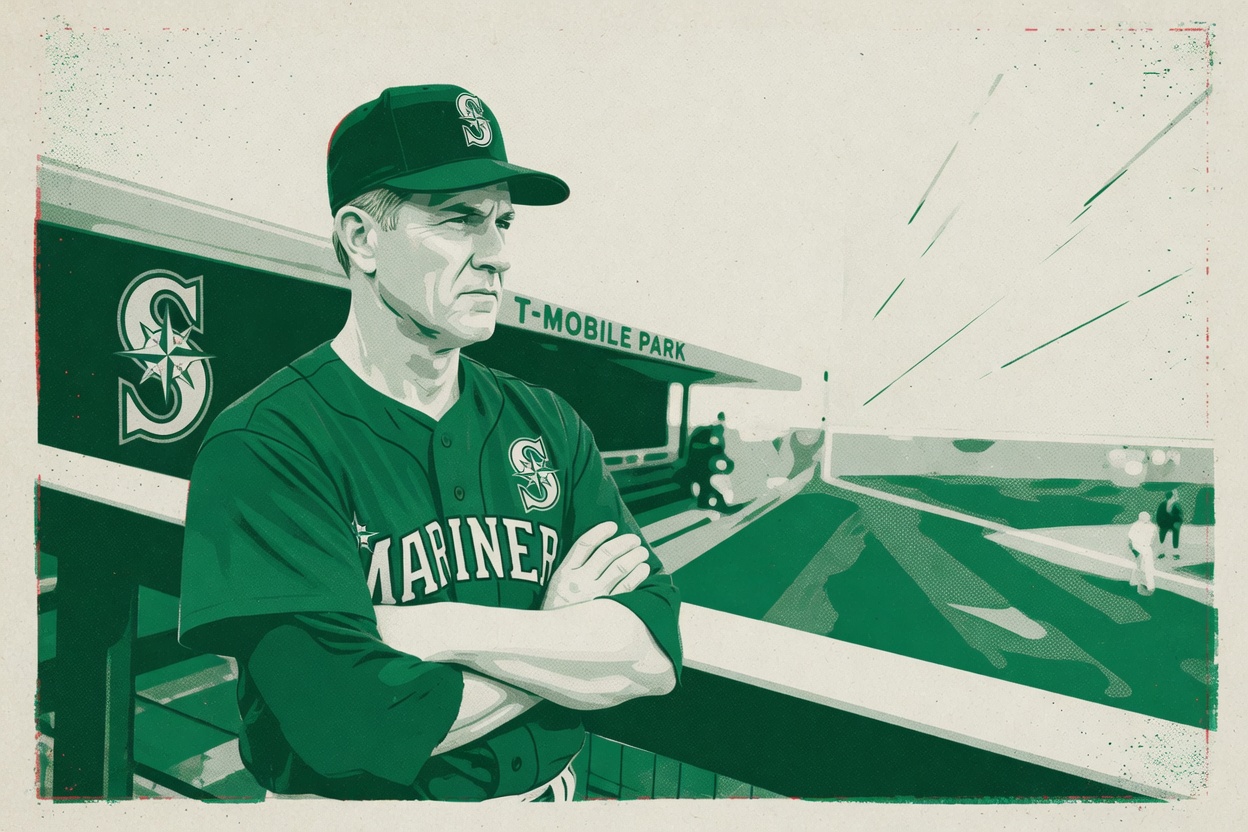
Start with what the reporting actually says. Dan Wilson is thought to be unlikely to return as Mariners manager in 2027, sources told Adam Jude of the Seattle Times. No official decision has been made. In that same reporting, the fates of general manager Justin Hollander and president of baseball operations Jerry Dipoto remain up in the air, with no sign a front-office shakeup is coming.
So ask who actually built the roster that fell apart. Here's the timeline worth remembering. The Mariners hired Wilson in August 2024 to replace the fired Scott Servais. He had no professional managerial experience. He was working as a special assignment coordinator at the time: a Mariners catcher from 1994 to 2005, a member of the team's Hall of Fame, who'd rejoined the organization as a minor league catching coordinator back in 2013. He wasn't a groomed managerial prospect getting his shot; he was an emergency, low-cost hire dropped into a midseason crisis. He took over a 64-64 team, went 21-13 the rest of the way, and finished 85-77, which wasn't enough for a playoff berth.
Then he did something almost no first-year manager gets to do. In his first full season in 2025, Wilson guided the Mariners to 90 wins and their first AL West title in 24 years. They pushed to Game 7 of the ALCS, the first Game 7 in franchise history, before Toronto ended it. Wilson finished third in AL Manager of the Year voting.
So the story you're being sold is that a manager went from a franchise-best October and near-unanimous respect to fireable incompetent in the span of one winter. That doesn't happen. Managers don't forget how to manage in eleven months.
What changed was the roster, and how the people who assembled it performed.
Seattle came into 2026 as a genuine contender on paper. FanGraphs had them at an AL-leading 79.6% playoff odds on Opening Day. The front office brought back a full season of Josh Naylor and added Brendan Donovan in a trade with the Cardinals. ESPN's Bradford Doolittle projected the Mariners to have the No. 4 lineup in baseball. Those were the expectations the front office set. Wilson didn't draw up the depth chart. He inherited it.
And it broke in ways a manager cannot fix from the dugout. The offense that finished tied-ninth in scoring in 2025, powered by the third-most homers in the majors, had cratered to tied-25th by late June at just 4.02 runs a game. Then the pitching fell apart completely. In August 2026 the staff gave up 169 runs, a 5.97 ERA, and only the A's surrendered more. Adjusted for park and league, that was a 154 ERA-, meaning they allowed 54% more runs than average, the worst pitching month in franchise history by that measure with data going back to 2002. By the back half of the season, the Mariners ranked second-worst in baseball by WAR, ahead of only the Rockies.
The bullpen is where this gets personal for the front office. Andrés Muñoz went from a 1.73 ERA over 64 appearances in 2025 to somewhere north of four this year, and by mid-September he'd blown a league-worst 10 saves. The bullpen's ERA jumped from 3.72, ninth in the majors, to 4.55, 23rd. When your best reliever regresses that hard and the rest of the relief corps follows him off the cliff, that's a personnel problem. A manager can't fix a bullpen that can't hold a lead.
Firing Wilson while keeping Dipoto and Hollander is the easy call, not the right one. It's cheaper and cleaner: it lets ownership tell fans they did something without admitting the people who built a would-be contender watched it become the second-worst team in baseball over the second half of the season. The manager is the visible face, the guy standing in the dugout when the wheels come off. That makes him convenient. It doesn't make him responsible for a bullpen ERA or an offense stuck in the bottom third.
None of this is final. The 2026 season isn't even over as of this writing. Seattle sat at 72-82 with eight games left, their playoff odds down to 0.5% at FanGraphs, and by BetMGM's numbers a few days earlier they trailed the final wild-card spot by seven games. Postseason play is set to begin September 29, and the Mariners will be watching. Maybe the front office reconsiders, or maybe everybody's job ends up on the table.
But if the outcome is that the man who delivered the best October in franchise history walks while the executives who built a collapsing roster stay, Seattle will have learned exactly the wrong lesson from a lost season. You don't hire someone in the middle of a fire, watch him produce a division title, and then hand him the blame when the plumbing you installed bursts a year later.
Wilson may not be the manager who takes this team back to contention. That's a fair debate. But the case against him is being built on a season that a front office designed. If somebody has to answer for 2026, start with the people who picked the players.