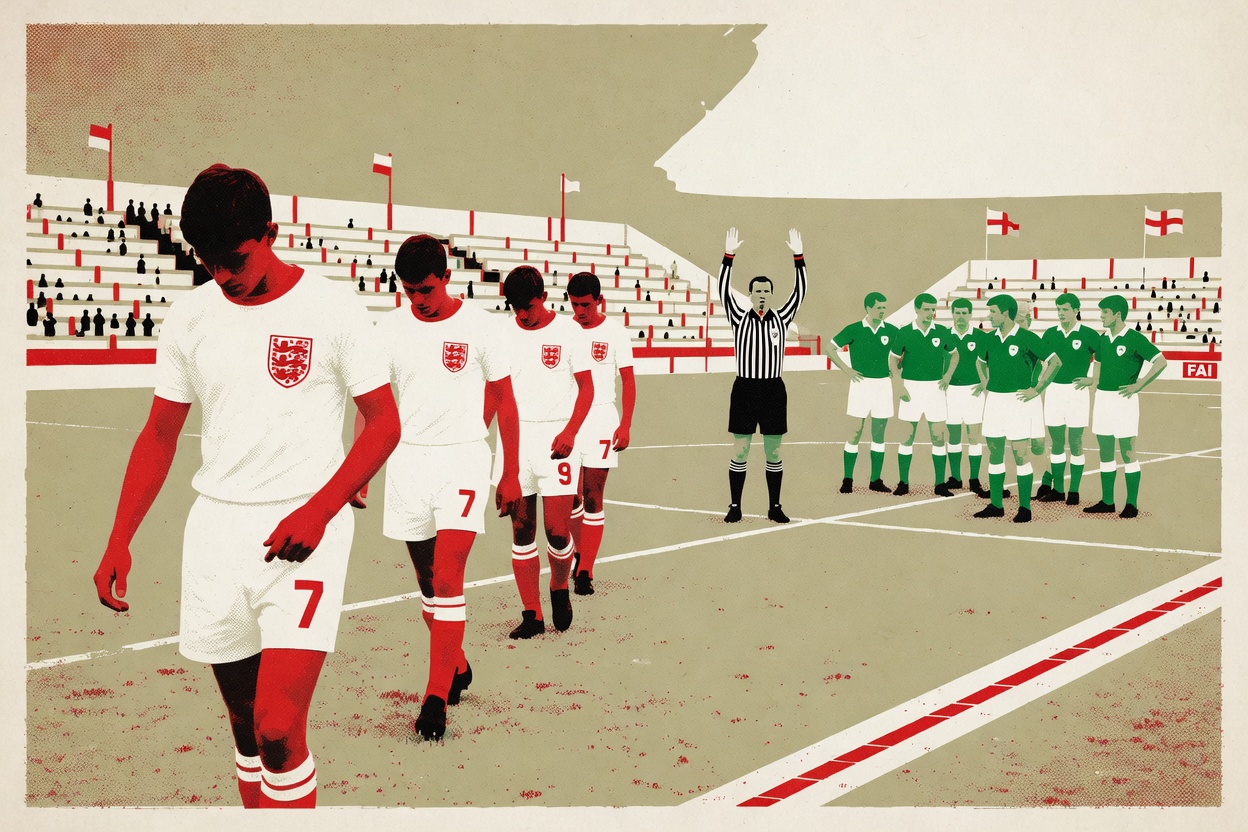
The one thing you can say with total confidence about the reports of an England U15 walk-off against Ireland is this: you don't know what was said, and neither does anyone else firing off an opinion about it right now.
The argument raging online splits neatly in two. One side has decided a slur was shouted and that's that. The other side thinks an ordinary insult was misheard and turned into something far uglier in the noise of a match. Both camps are performing certainty neither of them has earned. A teenager's account and a bench's denial are the two things being weighed, and not one person refreshing their feed was close enough to hear.
That's the whole problem with how these things get resolved now. The verdict arrives within hours, long before any neutral has done a scrap of work, and it arrives shaped by who you were already inclined to believe. Watch how quickly "could easily have been misheard" appears when the accused team is one people instinctively like. The benefit of the doubt gets handed out according to the crest on the shirt. There isn't any evidence in public yet.
This exact dispute keeps happening at underage level, and it always ends the same way. In June 2023 the Republic of Ireland U21s' friendly against Kuwait U22s was abandoned in Austria after an alleged racist remark, with Ireland leading 3-0. Kuwait's Olympic football director said the game "was not completed due to roughness and excessive tension between the players." One side alleges racism, the other calls it a misunderstanding, and the match collapses in acrimony before a single impartial person has examined anything, the same pattern playing out again.
And Ireland's youth teams have been on both ends of this. Two Ireland U15 internationals were allegedly racially abused during a playoff against the United Arab Emirates at the Torneo delle Nazioni in Italy in May 2025. In March 2025 the FAI complained to UEFA over alleged racist abuse of a Republic of Ireland U17 player during a qualifier against Poland. These allegations are taken seriously when Irish kids are the targets, as they should be. The standard cannot flip the moment the finger points the other way.
What should have happened, and what still should, is boring and correct. The sport has a three-step protocol for exactly this: pause the match for an announcement, suspend it, and abandon it only as a last resort. It exists so a referee isn't left improvising under pressure and so an allegation gets logged and handled rather than argued out between two sets of furious teenagers. Germany's Olympic side walked off against Honduras in 2021 after a player was allegedly abused, with the coach saying, "When one of our players is racially abused, playing on is not an option." When England's senior players debated this, Gareth Southgate and Raheem Sterling said they'd follow the officials and the protocol rather than walk off unilaterally, because they didn't want the players to become the story. A youth setup's job is the same: protect the child, start the process, and let qualified adults sort out the facts.
The responsibility sits with adults now. The player who made the claim deserves a proper hearing from people with standing instead of a cross-examination from strangers online. The opposing player deserves the same presumption until someone with standing says otherwise. The FA and the FAI, with the tournament organisers and whoever has oversight, have to run a formal, neutral investigation and then say plainly what they found. If a slur was used, the federation whose player used it has a real problem and should be made to own it in public. If a word was genuinely misheard, say that too, clearly, so a kid isn't left carrying an accusation that didn't hold.
None of that can be settled by a thread of thousands of people who weren't there, deciding they know exactly what was said through a phone screen. They can't. Wait for the people who can.