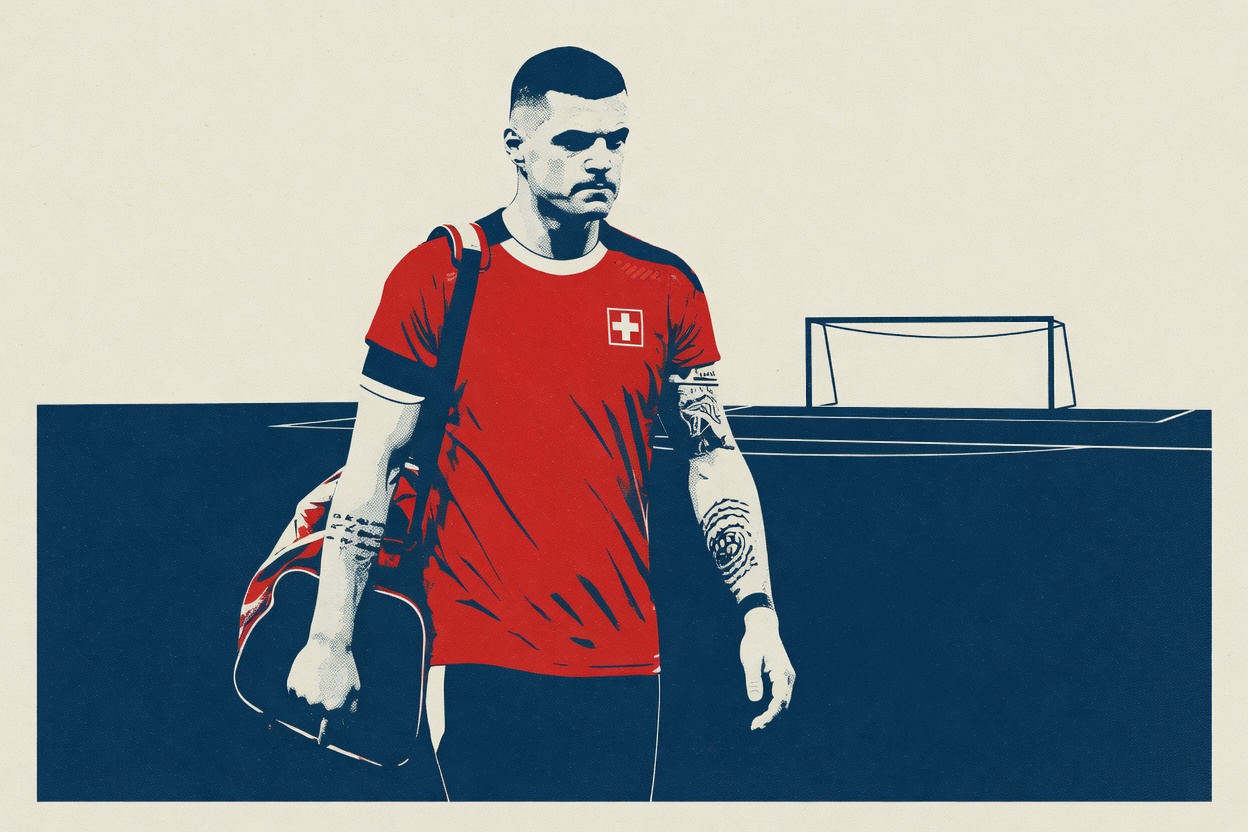
Granit Xhaka did the honest thing, and his federation immediately spent that honesty on making the whole affair disappear. He admitted in a statement on Monday that he obtained a fake Covid-19 vaccination certificate during the pandemic, called it "the wrong course of action" and "a mistake," and withdrew from the Switzerland squad while Lucerne prosecutors run a criminal investigation into him. That's more candor than most players offer when the receipts come out. It's also the last moment in this story where anyone treated it seriously.
Start with what Xhaka actually said, because his words matter more than any spokesman's spin. "At the time, I was deeply unsettled and had serious reservations regarding the Covid-19 vaccination," he wrote. "I harboured a deep mistrust of the vaccine and was gripped by fear and uncertainty. In that state of emotional turmoil, I obtained a vaccination certificate instead of addressing my unresolved questions through the proper channels." He added: "Today, I clearly see that this was the wrong course of action. It was a mistake." He said he accepts responsibility and will cooperate with authorities. Fine. That's the right register.
This admission arrived after a very different public story. Back in March 2022, Xhaka told the Swiss outlet 20 Minuten, "Yes, I am vaccinated, so you have nothing more to write about." His representatives kept maintaining he had been vaccinated, and his spokesman even pointed to a confirmation from the treating physician that Xhaka received jabs in January and November of 2022. His current apology quietly abandons that framing. And the doctor at the center of the case, a Lucerne physician suspected of issuing certificates without administering the vaccine, still denies any wrongdoing through her lawyer, who insists she vaccinated Xhaka and followed the rules. Prosecutors haven't resolved that yet. Their stated job is to determine "whether there is conduct relevant under criminal law in connection with a possible procurement of a false certification by deception and/or forgery of documents." He's expected to be questioned in early October. He hasn't been charged, let alone convicted, and if it comes to that he could face up to a five-year prison sentence, though a fine has been deemed enough in past cases. This investigation is still open.
Swiss FA president Peter Knäbel framed the withdrawal as a shared decision, saying he and Xhaka "jointly concluded that it is in the team's best interest to complete this training camp without him," with the priority being "to calm the situation." He then confirmed Xhaka could be back for November's internationals and said there had been no discussion of him surrendering the captaincy. So the punishment, such as it is, is missing one training camp before returning to lead the side. Xhaka has kept the armband at club and country throughout. The word "mutual" does all the work here: it turns a criminal probe into a scheduling courtesy.
Swiss sport knows how to do this differently, because it just did. Patrick Fischer, the former Switzerland men's ice hockey coach, was fired this year after reports he bought a fake vaccination certificate on social media to meet the entry requirement for the 2022 Beijing Olympics; he was fined nearly 39,000 Swiss francs in 2023 for document forgery. The hockey federation initially waved it off as closed because he'd admitted his error, then reversed course within days under public pressure. And it didn't stop at the domestic firing: the IIHF banned Fischer from coaching any national team until 2030. An international body looked at a case a domestic one tried to bury and imposed real, lasting consequences.
Knäbel pushed back on the comparison: Fischer needed the certificate to satisfy a hard Olympic entry rule, whereas Swiss soccer authorities only recommended players get vaccinated. That distinction is genuine. It also has nothing to do with the offense being investigated. Forging a certificate is forging a certificate, whatever door it was meant to open. The reason someone falsifies a document doesn't change whether they falsified it.
And football, so far, has offered nothing. Sunderland manager Régis Le Bris said it wasn't his "area to speak about those problems or situations," and Xhaka played the full 90 in the club's 5-3 defeat at Manchester City on September 20, which left them 14th through five matches. Sunderland's own line is that the incident happened while Xhaka was at Arsenal, so it's not really their business. The Premier League has said nothing. The credit Xhaka earned by telling the truth is real. The problem is that his institutions took that honesty and used it as an excuse to do less.