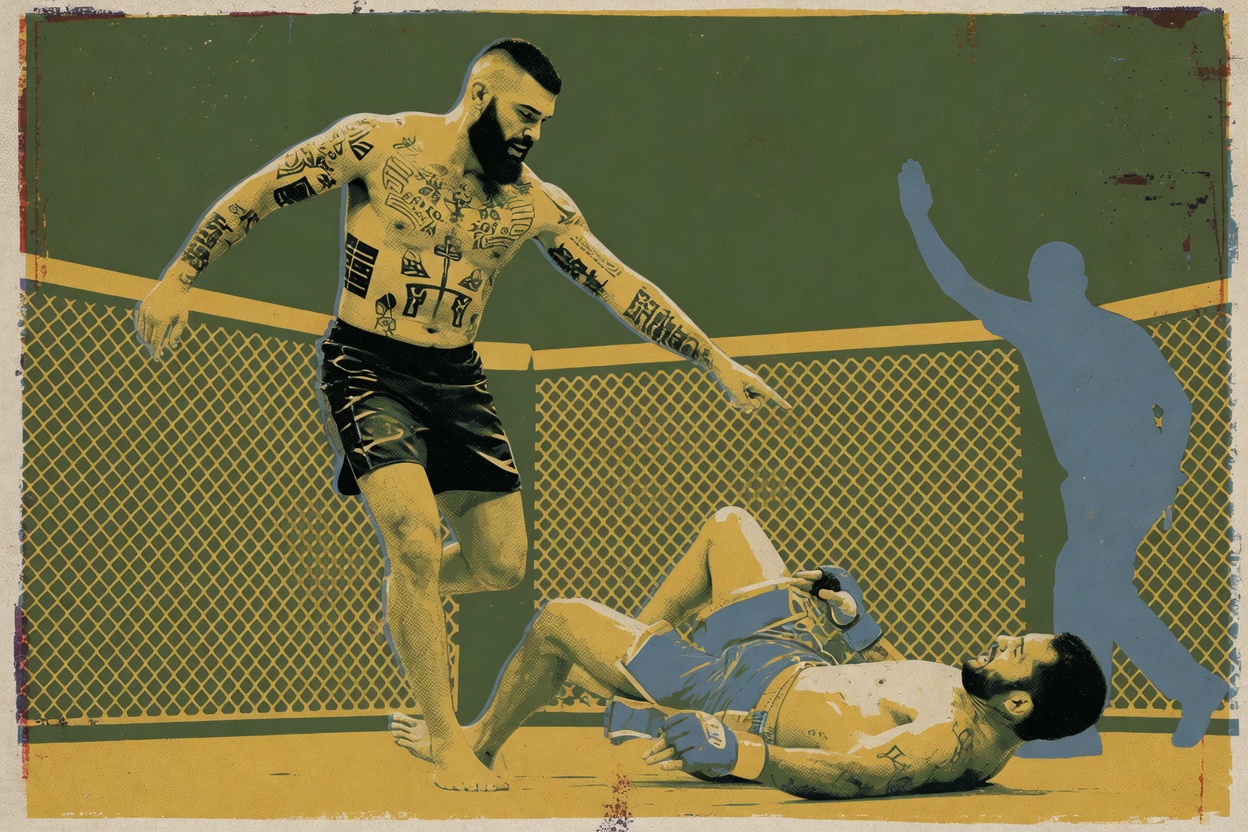
The check and the X-ray order arrived together. Gregory Rodrigues and Anthony Hernandez each walked out of the Golden 1 Center on August 22 with a $100,000 Fight of the Night bonus, and within a day or two the California State Athletic Commission handed them each a 180-day medical suspension, pending physician clearance, over a possible fracture. Rodrigues for his right leg, Hernandez for his left knee. Same fight, same money, same potential broken bone. That's the whole transaction laid bare, worth sitting with before anyone gets back to arguing about who deserves Dricus du Plessis next.
I'm not going to pretend the fight itself was anything less than the reason people bought the card. Rodrigues, "Robocop," knocked Hernandez down repeatedly (the exact count is being reported a couple of different ways) and turned back the vast majority of Hernandez's takedown attempts across a five-round grind that the judges scored 48-47, 49-46, and 48-47. It was tremendous by any fan's measure. Rodrigues grabbed the mic afterward and called out du Plessis: "Dricus du Plessis, where are you, man? I want you!" Great fight, great theater. The bill for it may be two men on crutches.
The bonus is the part that always gets sold as a happy ending, and it isn't a scandal on its own. Fighters want that $100,000, and they earn it. But the incentive underneath it is worth naming plainly: the promotion pays a premium for the fights that do the most damage. Nobody hands out Fight of the Night for a clean, low-risk points win. The reward is calibrated to how much punishment two people are willing to absorb, and the medical suspension list quietly totals up what that punishment cost. Rodrigues and Hernandez were paid, in effect, for the trauma that put them on the shelf.
The commission's paperwork gets interesting here, and this is where the more useful criticism lives. The same Sacramento card produced suspensions ranging from a seven-day mandatory rest all the way to 180 days. On its face, that spread makes sense. Jamall Emmers scored a knockout over Lerryan Douglas and got the seven-day minimum; Douglas, whose coach Cub Swanson said suffered a broken orbital bone and lost some vision, got 180 days for a possible right orbital fracture. The man who got hurt sits longer than the man who didn't. No argument there.
But look one line further down the list. Marquel Mederos won his fight by knockout and still drew a 180-day suspension for a possible fracture to his right orbital. A winner, going home with a Performance of the Night bonus of his own, facing the same six-month window as the guy he beat unconscious. That's the detail that undercuts the tidy story that suspension length maps neatly onto winning and losing. It maps onto injury, and injury doesn't check the scorecards.
That's the real hole in how combat sports handles this. The 180-day figure isn't a diagnosis. It's the commission's standard precautionary ceiling: a fighter with a suspected fracture is out for up to six months or until a doctor clears them, whichever comes first, which is why plenty of these long suspensions dissolve the moment a follow-up scan comes back clean. That flexibility makes sense in isolation. But it means the system leans almost entirely on case-by-case physician sign-off rather than fixed, injury-specific protocols that everyone can see and trust. Two fighters with suspected leg fractures in the same cage get the same ceiling; two different orbital injuries on the same card get the same ceiling. The number is a placeholder, not a standard, and the real decision happens later, out of public view, in a doctor's office.
I don't think the fix is to stop paying Fight of the Night bonuses, and I don't think 180 days should be treated as a guaranteed layoff, because for most of these fighters it won't be. What I'd push for is honesty about the trade. When a promotion pays a premium for damage and a commission responds with a one-size window pending a clearance nobody outside the process ever sees, you've got a system that rewards the risk on Saturday night and improvises the accounting on Monday. Rodrigues and Hernandez put on the best fight of the weekend. They may also be looking at surgery consults. Both are true, and the sport still doesn't have a consistent way of reconciling them.