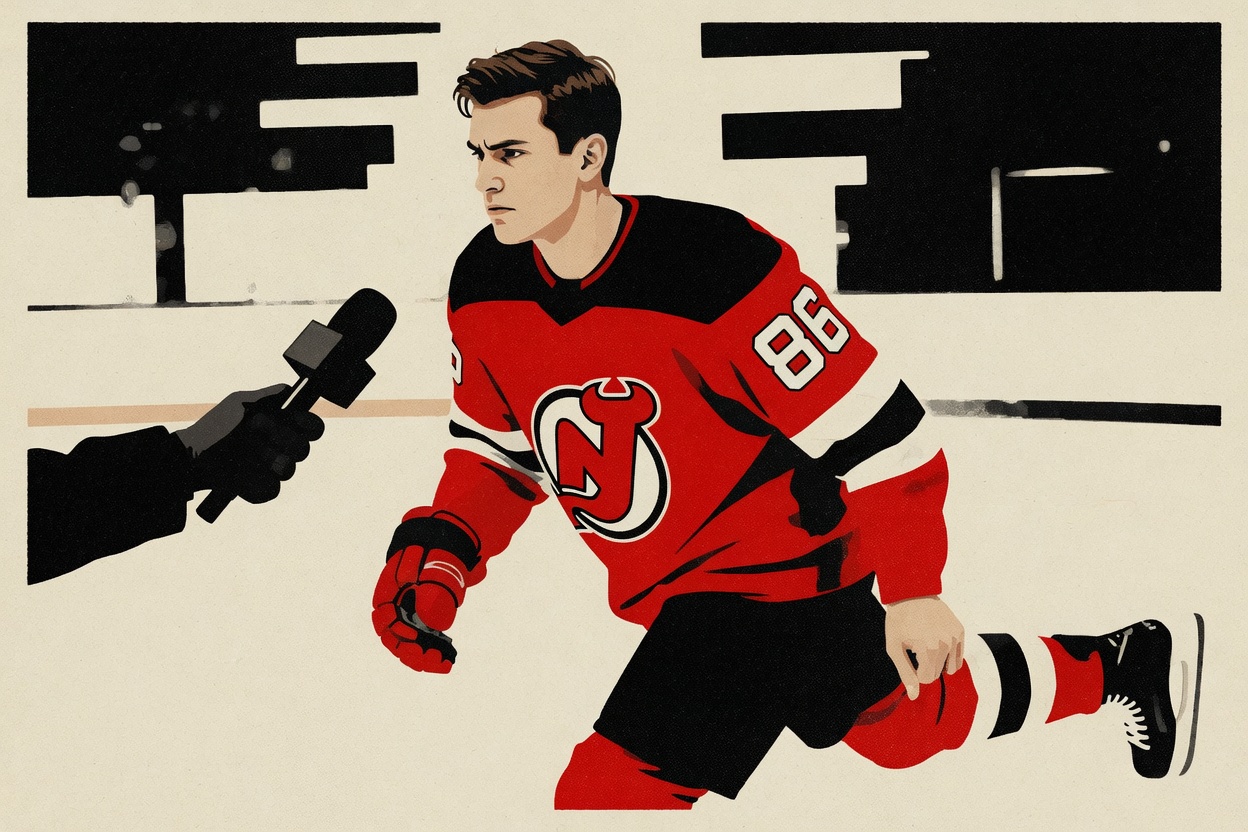
Most teams that win a Stanley Cup spend the next summer admiring it. The Carolina Hurricanes, fresh off beating the Vegas Golden Knights in the 2026 Final, spent part of theirs adding a college scorer for the price of a phone call.
On Monday, August 17, 2026, Carolina acquired forward Stiven Sardarian from the Buffalo Sabres in exchange for future considerations. In hockey terms, that's about as close to free as a trade gets. Sardarian was assigned straight to the American Hockey League's Chicago Wolves. Let's be clear about what this is: a low-stakes swing on a development prospect. He hasn't even signed an NHL deal yet, and that's still up in the air.
A future-considerations trade in the dog days of August doesn't usually merit a column. This one does because of who's making it, and how often they keep making them.
The player is intriguing on his own
Sardarian isn't a random name pulled off a waiver wire. He was Buffalo's third-round pick, 88th overall, in the 2021 NHL Draft. This past season at Michigan Tech he put up 44 points (12 goals, 32 assists) in 37 games, and the Central Collegiate Hockey Association named him its Forward of the Year, along with a First All-Star Team nod after he led the conference in assists and points. Across four NCAA seasons split between New Hampshire and Michigan Tech, he recorded 32 goals and 100 points in 133 games. Several outlets list him at 23.
That's a genuinely productive college career, and it landed in Carolina's lap because of a technicality. Sardarian was on track to become an unrestricted free agent in mid-August as an unsigned collegiate prospect, but that outcome hinged on him informing the NHL Central Registry he was no longer an undergraduate. He never did. Rather than watch the window slam shut, Buffalo moved him for whatever it could get, and Carolina was waiting.
The pattern is the story
The trade itself is minor. But it's the latest example of a team-building method other contenders should be copying instead of coasting on their own good fortune.
Under general manager Eric Tulsky, promoted in 2024, the Hurricanes have built a habit of squeezing value out of assets other clubs undervalue or give up on. The championship roster wasn't assembled by luck. Tulsky's approach has ranged from bold to opportunistic: he traded for Mikko Rantanen in January 2025 without an extension in hand, and when that gamble didn't take, he flipped Rantanen to Dallas that March and came away with Logan Stankoven plus conditional first-round picks in the 2026 and 2028 drafts and a third-round pick. Even a swing-and-miss turned into future ammunition. Around that, Tulsky reworked the defense with additions like Shayne Gostisbehere and Sean Walker, and Alexander Nikishin arrived full-time this past season.
The Sardarian deal fits that shape. It costs almost nothing, and it carries real upside if he develops. If he doesn't, Carolina is out a future consideration and a roster spot in Chicago. That's the kind of risk-to-reward math a smart front office runs constantly. Most swings won't connect, but the few that do pay for all the rest.
What I'm not saying
I'm not predicting Sardarian becomes an NHL player, let alone a Carolina regular. He's headed to the AHL, joining a Wolves group that just lost in the Calder Cup Final to the Toronto Marlies. The path from CCHA Forward of the Year to a Cup contender's lineup is long, and plenty of decorated college scorers never finish it. Anything beyond that is speculation.
What I am saying is that the instinct on display here is the real asset. A champion could be forgiven for taking August off. Carolina instead kept working the margins of the market, chasing a scorer whose only real flaw, from a buyer's perspective, was a paperwork quirk that made him cheap.
Hockey media has already started pointing to Carolina as a model worth studying. This trade won't make or break the Hurricanes' next season. But the refusal to stop hunting for value, even with the Cup already in the case, is exactly why they were holding it in the first place.