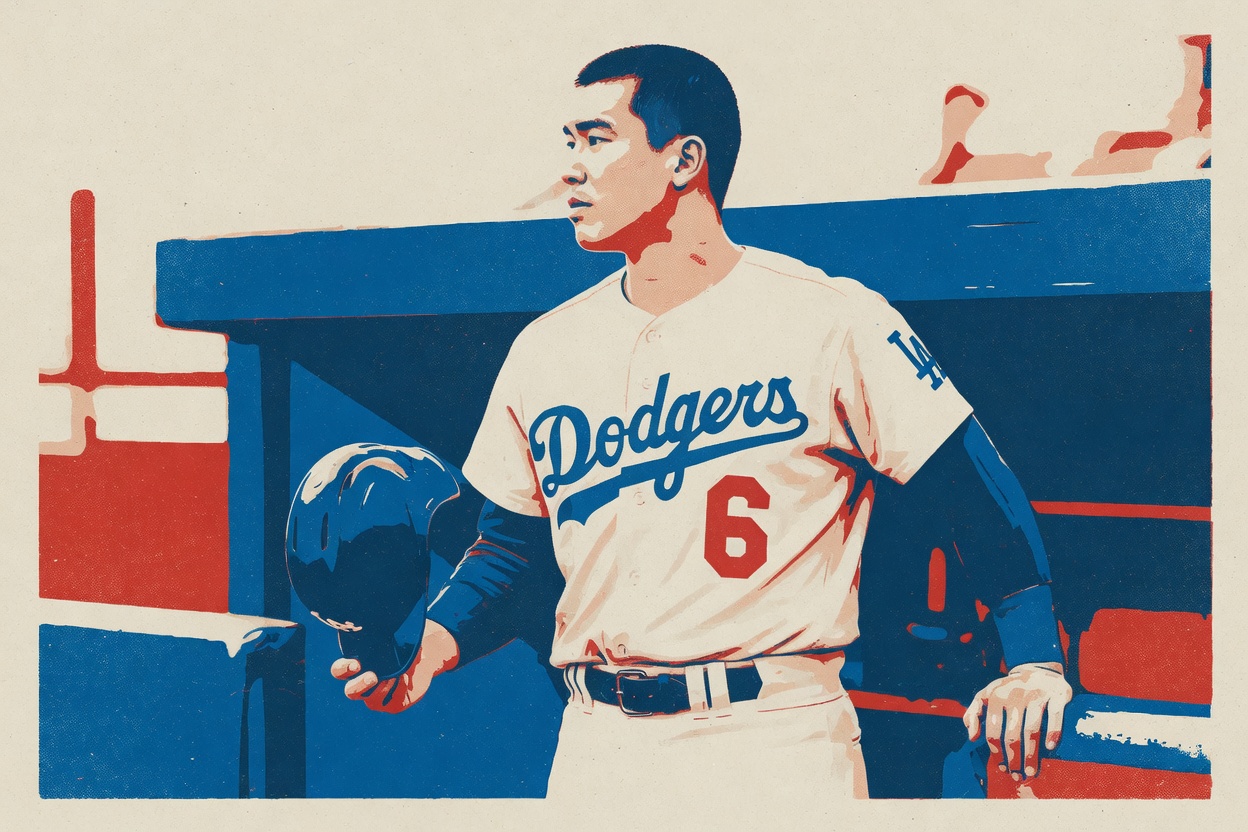
Hyeseong Kim says 2026 with the Dodgers was the most disappointing year of his baseball career, and the loudest version of why is the convenient one: he didn't hit, so he didn't play. That version lets the Dodgers off the hook. It shouldn't.
Here's what Kim actually said: "The fact that I was only in the Major Leagues for about a month, that's what hurts the most. I want to play in the Major Leagues for a long time, but I wasn't able to make that happen." He also added, "It is the most disappointing thing I've experienced while playing baseball." To his credit, he didn't hide behind the roster. He said he needs to improve his hitting to establish himself as a regular. So let's give him the respect of not pretending his bat was great. It wasn't.
But it wasn't a disaster either. Through 43 games with the Dodgers, Kim hit .259/.323/.328 with one home run, 11 RBIs and a .651 OPS. Pull up Alex Freeland's line over the same season: 89 games, .234/.327/.325, a .652 OPS. That is a coin flip. Two players producing the same thing, and one of them got roughly twice the games. The roster created that gap.
And the roster was the problem from the first day. When the Dodgers signed Kim on January 3, 2025, to a three-year, $12.5 million deal that could climb toward $22 million with options, the surplus was obvious enough that MLB.com flagged it in the announcement itself: this was a position group where the team already had too many bodies on the 40-man. Kim then spent 2026 playing behind Mookie Betts, and he started the year in Triple-A only because he'd already lost the spring battle for an infield job to Freeland. He got his chance when Betts went down with an oblique, came out hot, carried an average near .300 through April with a .760 OPS, and still got optioned back near the end of May. He never returned to the regular-season roster.
The clearest tell came later. Even with Kiké Hernández out, the Dodgers went with Freeland over Kim. A veteran was hurt, a lane opened, and they still chose the younger, cheaper option. That's a front office deciding, again, that he was the odd man out. By October it was the same story: he made the NLDS roster against Atlanta, appeared in exactly one game, and got bumped off the NLCS roster entirely so the Dodgers could carry another arm.
Mostly the front office owns this. They built a payroll stuffed with Betts, Hernández, Tommy Edman, Max Muncy, Miguel Rojas and a rookie, then handed $12.5 million to a self-described super-utility piece and acted surprised there was no room. Kim's job was to force his way in, and on this roster that was never going to happen with league-average numbers. Everyone could see that before he signed, including, probably, the people who signed him.
Some of this is on Kim. He said it himself: a better bat buries the argument entirely. If he'd slugged his way to an .800 OPS, no logjam holds him down. He didn't. But "be dramatically better than the field" is a standard nobody applies to the other names on that bench, and it only exists for Kim because the Dodgers spent the winter making sure it would.
The opening he wanted may finally come. Rojas has retired, Hernández's future is unsettled as free agency plays out, and for the first time the infield in front of Kim might actually thin. If 2027 is the year he gets a real runway, good. The lesson of 2026 is that a player can do roughly everything a teammate does and still spend the summer in Oklahoma City, because the people who wrote the checks never cleared him a chair. Blame the bat if you want. The front office built the room.