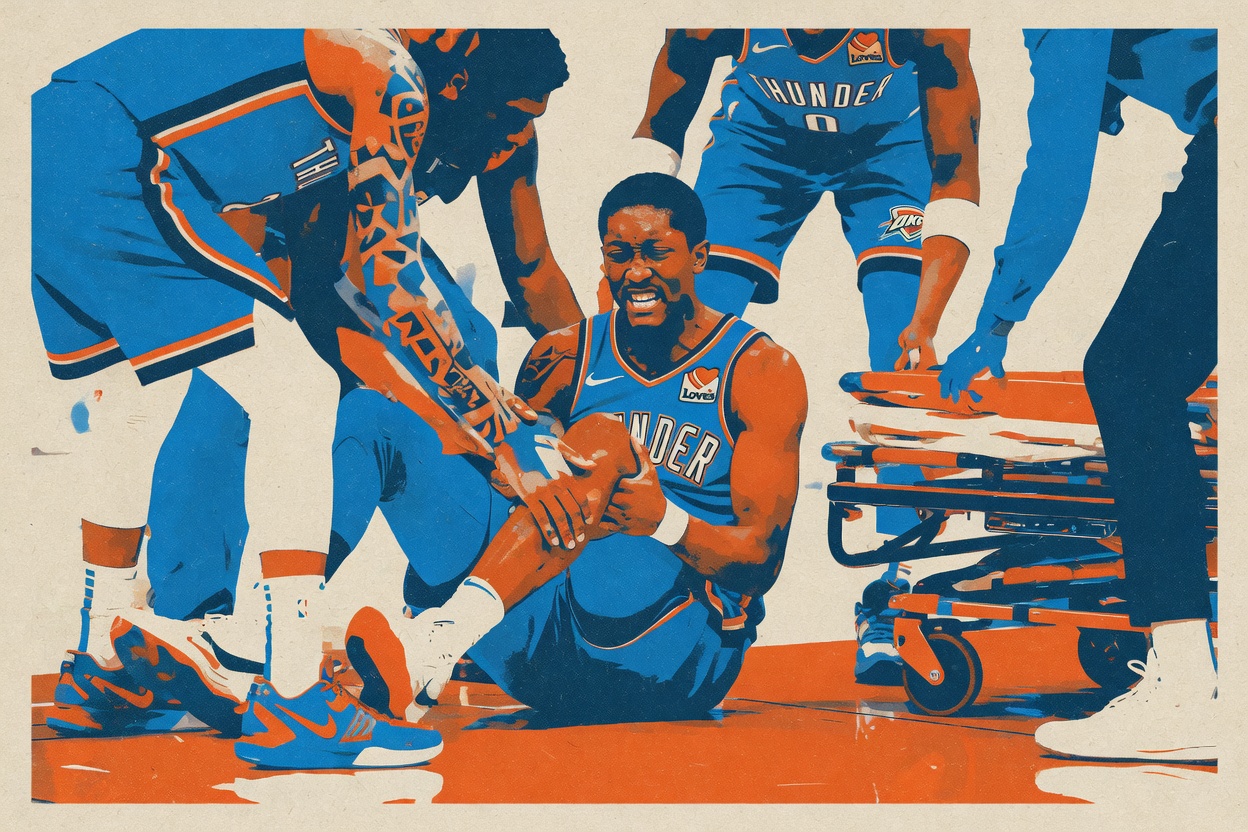

Here is where the Detroit Pistons find themselves as of September 11, 2026: their All-Star center is the last restricted free agent in the NBA who hasn't signed a deal, and he's reportedly warming to the idea of playing next season for pocket change.
Jalen Duren, an All-Star and third-team All-NBA pick last season for the Eastern Conference's No. 1 seed, is weighing whether to take a $9.6 million qualifying offer instead of a multi-year contract that would guarantee him well north of $150 million. One source briefed on the process told Marc Stein that Duren is increasingly prepared to play the 2026-27 season on that qualifying offer and hit unrestricted free agency next summer. Bleacher Report, citing The Athletic, has the same read: Duren is "very seriously considering" that route.
Stein adds the skepticism, and it's worth passing along, because it's the smart instinct. Plenty of people will doubt a 22-year-old is "truly willing to go the qualifying offer route until it actually happens." Threatening to torch tens of millions in guaranteed money is exactly the kind of thing agents float and players rarely follow through on.
But the fact that Duren is even letting this leak shows how little a modern restricted free agent trusts the system that controls his value.
The math says this isn't really about the math
Start with the gap. It's moved all month, so it's worth tracking. Back on September 1, the reporting had Detroit offering around $35 million a year while Duren's camp, led by agent Chafie Fields, wanted an average north of $40 million. By September 8, The Athletic's Sam Amick was cooling things down: "There is a gap. It's not as big as I thought it was before having a few recent conversations." The latest figures have Duren seeking at least $200 million against Detroit's last offer of five years and $190 million. Call it roughly a $10 million total-value difference.
Here's the part that changes the read. Hoops Rumors ran the numbers on the nuclear option: if Duren signs the $9.6 million qualifying offer this year and then lands a max deal with a rival team in 2027 as an unrestricted free agent, he'd project to earn about $196.7 million over the next five seasons. That's barely more than the $190 million already sitting in front of him, and only if the gamble breaks perfectly.
So the pure-dollars case for betting on himself is thin. He isn't chasing a bigger number. He'd rather control his own exit than let Detroit dictate the terms of his career. When a player is willing to risk a season of injury and a soft market just to hold the pen next summer, the disagreement stopped being about money a while ago. It's about who owns his future.
Detroit's Kings problem is self-inflicted
The front office is playing this badly.
There's reported mutual interest between Duren and the Sacramento Kings, and Duren apparently wouldn't mind the destination. That's a real market, and real leverage Detroit could turn into actual players in return.
Instead, Detroit has flatly refused to engage the Kings or anyone else in sign-and-trade talks. Tim MacMahon reported it in blunt terms: Detroit made clear to anybody circling in a sign-and-trade that "you're wasting your time." Go back further and a source told the Detroit News on June 30 that the Pistons had "no interest" in trading Duren at all.
The posture makes sense on its face. You don't want to signal weakness on a player you value, and the Pistons "absolutely positively 100%" intend to keep him. Fine, hold the line in negotiations. But refusing to even take Sacramento's call is a different thing, and it's where the strategy tips into self-sabotage.
The endgame is obvious if this breaks the wrong way. Insiders note that Duren taking the qualifying offer would signal "a relationship gone wrong" and force Detroit to "consider trading him now rather than losing him for nothing later." Duren plays out the year on $9.6 million, walks in 2027, and the Pistons get zero back for a first-team building block next to Cade Cunningham. That's the worst outcome on the board, and Detroit is inching toward it by treating a live trade partner like a nuisance.
The Monroe ghost, and why it doesn't apply
Everyone reaches for this comparison. Former Piston Greg Monroe signed a $5.5 million qualifying offer in September 2014 and then cashed in the next summer with a three-year, $50 million deal from the Bucks. The bet-on-yourself template exists, and it worked.
But Monroe's situation was the opposite of this one. Stan Van Gundy had genuine fit concerns about Monroe next to Andre Drummond and never put a rich long-term offer on the table. Monroe bet on himself because Detroit wouldn't. Duren already has up to $190 million in front of him. He'd be betting on himself out of principle and leverage, not because the money isn't there.
That makes his gamble rarer and riskier. Since 1998, only 21 former first-round picks have signed the qualifying offer, and none took on anything close to the financial risk Duren would be swallowing here. If he pulls the trigger, it's less a contract strategy than a statement about trust.
The calendar is the villain now
Two dates hang over all of it. Media day is September 28, and it remains to be seen whether Duren even shows up. Training camp opens the day after. October 1 is the deadline to sign the qualifying offer, though the team can push that back if it wants.
My read: this still gets done. Ten million in total value is a bridgeable gap, and Amick's reporting on the sides narrowing points that way. But if it doesn't, the autopsy will be simple. Detroit had a willing trade partner in Sacramento and a franchise center drifting toward the exit, and chose to engage with neither. You can win a staring contest and still walk away with nothing to show for it.