Start with the number that makes people gasp, then look at the one that actually matters.
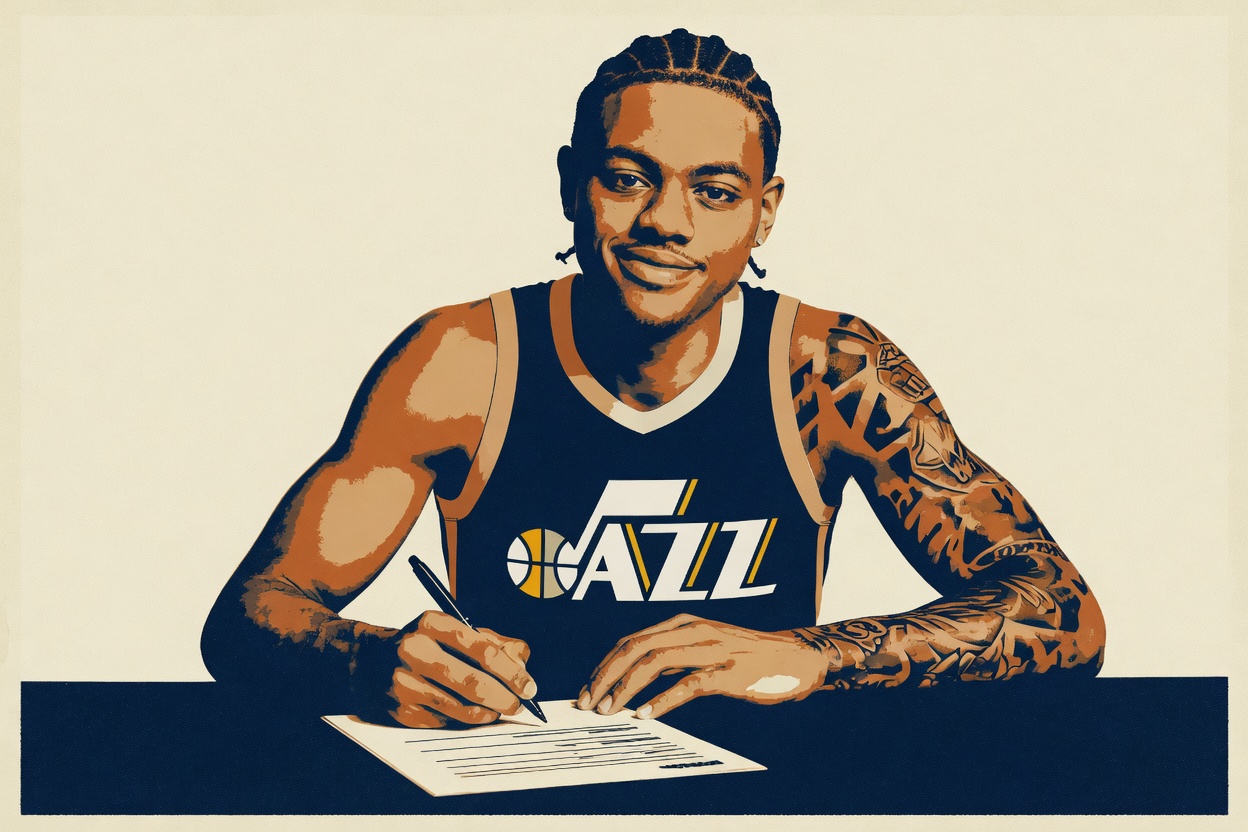
Keyonte George just signed a five-year, $157.5 million extension with the Utah Jazz, announced Friday. That's big, life-changing money, and still roughly $95 million short of the maximum extension he was eligible for, a deal that could have gone up to $252 million.
George left a fortune on the table for a rebuilding team, and got paid handsomely to lock in his life, both are true at once. He gave up a shot at $252 million to guarantee $157.5 million right now, with no options attached, and that gap says more about how he and the Jazz see the risk than the topline number does.
The "below market" label is lazy
The easy take falls apart pretty fast. Calling this deal cheap because it's under his personal max is like calling a great salary bad because it isn't the CEO's. Relative to recent non-max rookie-scale extensions for guards, $157.5 million over five years sits on the higher end, not the low one. This isn't a bargain-bin deal, it's a strong second contract that happens to be smaller than the theoretical ceiling almost nobody actually hits.
The max was always a fantasy number for George at this stage: you get max money when a team has no choice, when letting you walk would gut the roster. George isn't there yet. One breakout year doesn't buy the leverage of a proven All-Star, and the real question isn't why he took less than the max, it's what the structure tells us about how both sides see the risk.
Follow the structure, not the headline
The detail I keep coming back to: no team option, no player option. Fully guaranteed, both ways.
That's George saying he wanted certainty over upside. And you can see why. His career-best season, the one that earned this deal, came with real production: career highs of 23.6 points and 6.1 assists a game, plus 3.7 rebounds and 1.1 steals, on 45.6% from the field and 37.1% from three. After two straight years shooting 39.1% from the floor, that jump to 45.6% is the kind of leap teams pay for.
But it came in a partial season. George started all 54 games he played, and he was sidelined late with a hamstring issue, missing the finale and at least one other game down the stretch. When your value comes from one healthy, efficient run, locking in a fully guaranteed deal with no options is cashing in the ticket while the number's hot, not leaving money on the table. If the hamstring becomes a pattern, or the shooting regresses toward those old 39% seasons, George already banked $157.5 million that nobody can claw back.
That's not a knock, it's smart. A player who spent two seasons shooting under 40% and then broke out knows markets are fickle and bodies betray you.
What the Jazz are really paying for
The deal eats up around 16% of Utah's cap, a manageable price for a lead guard if the growth is real. Austin Ainge, the president of basketball operations, framed it the way you'd expect, calling George "an integral part of this franchise's future" and "a foundational piece as we continue chasing our ultimate goal: a championship."
That word, foundational, deserves a second look. This is a team coming off a 22-60 season, deep in a rebuild built on lottery picks. George isn't joining a contender, he's the veteran-priced piece on a roster still figuring out what it is. The bet cuts both ways: Utah is betting that a 2023 draftee taken 16th overall is a genuine building block, and George is betting that this roster grows up around him fast enough to make him look underpaid in three years.
If both bets hit, this is a steal for Utah and a launchpad for George, who could out-earn this deal on his next one. If the Jazz stall and George plateaus, it's a fair contract for a good guard on a bad team, and everyone shrugs.
The verdict
George didn't sell himself short. He read his own leverage correctly and protected himself against the exact risks his season flagged. The romantic version, where a young star sacrifices millions for a title chase, doesn't apply here because there's no title chase yet. There's a rebuild and a healthy hamstring's worth of doubt.
Call it a security play dressed up in franchise-cornerstone language. George bet on himself, but he hedged the bet, and given where he and the Jazz actually stand, that's the sharper move than swinging for a max he hadn't earned. The people who should be sweating aren't George's camp, it's the Jazz front office, who now have to make the rest of this roster worth his commitment.