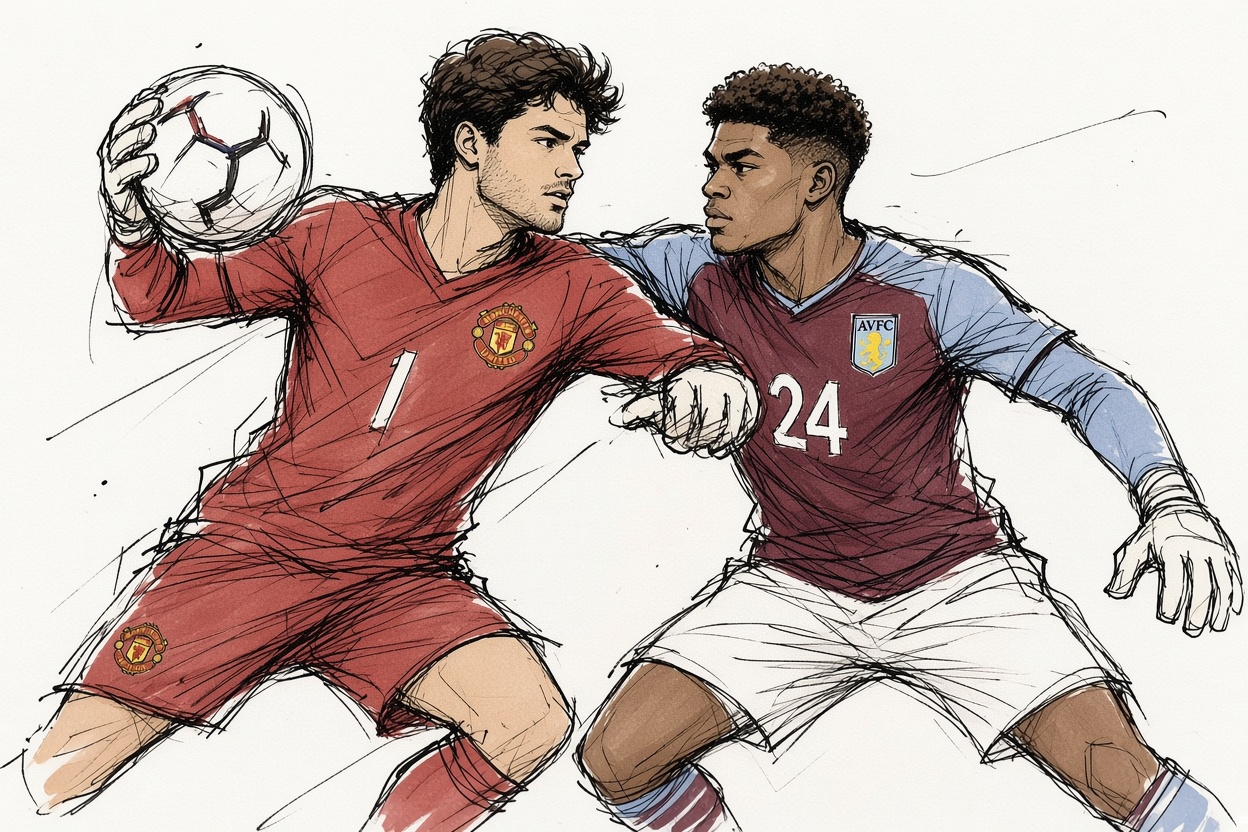
Yes, it was a foul. Senne Lammens drove his hip into Zion Suzuki with no interest in the ball whatsoever, Patrick Dorgu scored off the loose header, and Manchester United's 4-4 against Aston Villa is now one of the wilder comebacks you'll see. It shouldn't be. The equaliser should have been chalked off, and the people responsible for it standing are wearing headsets.
Lammens came up for the final attack, and as the cross came in he went straight into Suzuki's body. He never looked at the ball or jumped for it. He used himself as a barrier so Villa's goalkeeper couldn't claim a cross he was fully entitled to in his own six-yard box. The ball dropped, Dorgu pounced, and United finished off a stoppage-time escape that saw Joshua Zirkzee score in the 92nd minute before Dorgu leveled it. The escape itself was thrilling. The goal that finished it was obstruction.
Tim Sherwood's answer on Sky Sports gave away the whole problem, and it came up as a marquee talking point rather than a footnote. He said it straight: "I think it is a foul, but do you get it in the 96th minute at Old Trafford? No... Is Lammens looking at the ball? No. He is a goalkeeper and knows how much contact he needs to give Suzuki there." He thinks it's a foul. He also knows, from years of watching, that nobody blows for it when the clock reads 96, the home crowd is roaring, and the fixture is this one. A challenge that gets whistled at 0-0 in the fifteenth minute stops being a challenge in the sixth minute of stoppage time. It's crowd management with a rulebook held up as cover.




Dermot Gallagher, the former referee, backed the call: "it is one where the referee makes the decision... I think the referee is right." That's a decision about who holds the power, not about what happened. Roy Keane went the other way entirely, arguing Suzuki should have taken a step back and attacked the ball instead of standing underneath it. That's the "keepers should be stronger" line, and it's the exact thinking that makes this dangerous. If the standard is that goalkeepers must simply absorb whatever an opponent decides to put through them, you're inviting every attacker to lead with an elbow or a hip, because the penalty for doing so is nothing.
Goalkeepers do have to accept contact in a crowded box. Not every bump is a stoppable foul, and plenty of aerial duels involve bodies meeting without anyone deserving a free kick. This one is different for the reason everyone keeps pointing at: Lammens made no attempt to play the ball. Incidental contact happens when two players go for the same thing. This was one player going for the other player. That's the line, and it's not blurry.
Lammens made a choice, a cold and experienced one, because he'd calculated the risk of getting pinged was close to zero. Referee Chris Kavanagh didn't blow it in real time. The real failure is the VAR review that followed: VAR did look at this and let it stand. This isn't one bad night. There was a near-identical situation at the same ground last season, when Altay Bayindir appeared to be fouled by William Saliba before Riccardo Calafiori's winner, and VAR didn't recommend a review then either. Two incidents, same stadium, same outcome: goal stands. When the pattern repeats that cleanly, it's a protocol that has quietly decided goalkeeper-on-goalkeeper contact is an acceptable cost of doing business, right up until someone asks it to draw a line, and then it finds something else to look at.
Villa are furious and they're entitled to be. Director of football operations Damian Vidagany said they'd been warned about exactly this: "We've been told by referees during the summer that this season, pushing or unbalancing the goalkeeper on purpose inside the six-yard box was not going to be allowed anymore... Lammens didn't even look at the ball. He went straight to make contact with his hip on Zion. But the rules are the rules and must be respected." That's Villa's account of a pre-season promise, a claim from the club that lost two points. But the hip, and the ball he never glanced at, are on the video.
Unai Emery turned it into a gentler point about his keeper adapting to England, which was diplomatic of him. It also lets the officials off a hook they belong on. Suzuki failed to claim that cross because the laws, as they're actually applied on a Premier League pitch, let an opponent take the ball out of his reach before it arrived. Fix that and he catches it.
None of this rescues United's season. They went into the international break 18th with eight points from their first ten games, and a lucky point against Villa papers over nothing. The issue here isn't complicated: the Premier League keeps calling deliberate obstruction a contact sport, and it'll keep doing it until the keeper standing underneath the next one gets badly hurt proving the point.