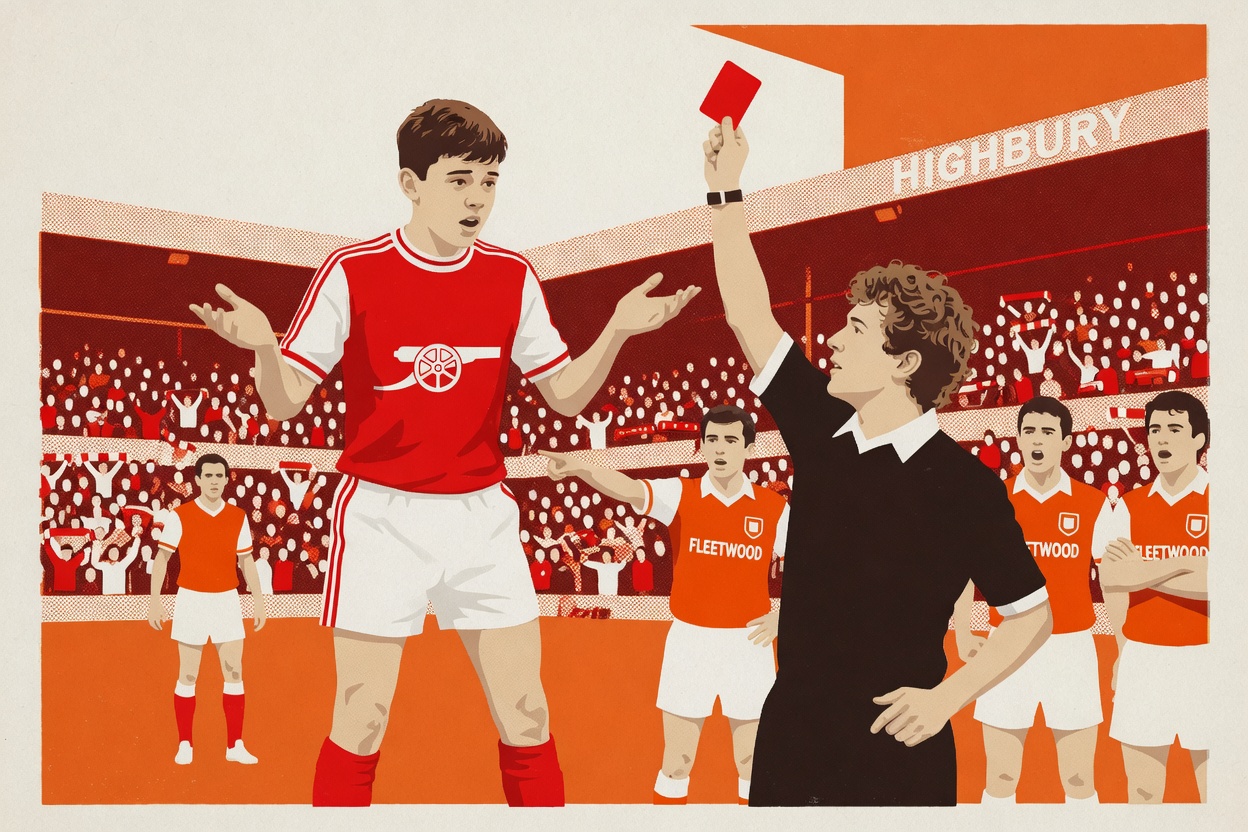
Max Dowman got a straight red card at Highbury on Tuesday. The challenge that provoked it got nothing at all. That's on the referee.
This was a Carabao Cup fourth-round tie, whatever the shorthand suggests, and League Two Fleetwood Town, sitting 18th in the fourth tier, knocked the reigning Premier League champions out 5-3 on penalties after a 1-1 draw. Aaron Loupalo-Bi put Fleetwood ahead in the 21st minute, Viktor Gyokeres bundled Arsenal level early in the second half, and the rest unravelled on spot-kicks. Eighty-four places separate these two clubs in the pyramid, and Fleetwood won. Good for them.
The red came with around five minutes of normal time left. Dowman, who'd been Arsenal's liveliest attacker all evening, reacted to a challenge from Harrison Neal, and referee Michael Salisbury produced a straight red. Arsenal's own match report calls Neal's tackle "reckless." There's no record of Neal being booked for it. The sequence Salisbury refereed: a reckless challenge from a 24-year-old professional, no card, then a reaction from a 16-year-old, straight red.
Accounts of what Dowman actually did split hard. Some call it a clear kick-out. Others call it a nudge in a scuffle, nothing close to violent. Reporters watching the same footage can't agree on what they saw. That split shouldn't exist for a dismissal that's supposed to be obvious.
Kick out at an opponent and you're guilty of violent conduct, provocation or not, and the letter of the law says red. Fine. But refereeing is not a vending machine. If you can watch a reckless tackle land on a child and not even reach for your pocket, then watch the response and instantly produce a red, you've refereed the retaliation and ignored the cause. The sensible reading of that passage was a card for each, or a word and a warning. A one-way straight red misreads the whole thing.
Responsibility sits with Salisbury. He set the tone by waving away the physical stuff, then came down like a hammer on the one incident involving the youngest player on the pitch. Proportion is the job. He didn't do it.
None of this makes Dowman a saint. He's 16, he's being talked about as one of the best academy prospects in the country, and reacting to provocation is exactly the lesson he'll be reminded of for years. Mikel Arteta was visibly furious with him down the tunnel, which drew criticism from Paul Merson, then offered a cool line in his press conference: "Yeah, we all learn from everything, yeah." A teenager learning not to bite is a fair outcome. A teenager being correctly sent off is a separate claim, and it isn't true.
The cost isn't abstract. A straight red for violent conduct normally carries a three-match domestic ban, which would rule Dowman out of Sunday's trip to Liverpool. Whether Arsenal appeal remains to be seen. They should, because the inconsistency here is the kind English officiating keeps producing. Only days earlier, Cole Palmer was sent off against Tottenham after an incident where fans and pundits felt provocation was waved through: a different referee and a different competition, but the same pattern of punishing the response and missing the cause.
A 16-year-old got dumped out of a cup tie for reacting to a foul that cost the man who committed it nothing. If you want to call that correctly refereed, you weren't watching the first half of the incident.