Baseball's offense problem is that pitchers have never been this good, and hitters haven't caught up. MLB's newest idea, naturally, is to tell outfielders where to stand.
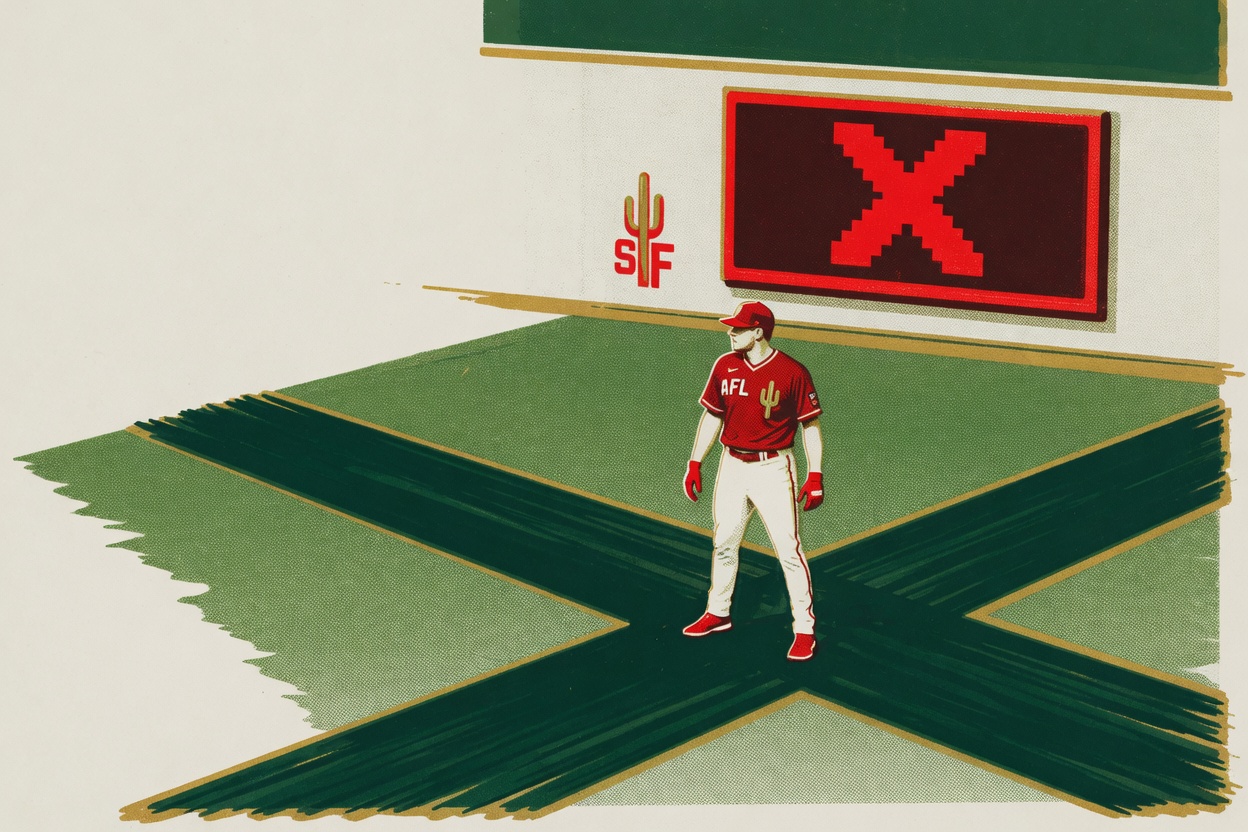
That's the experiment quietly running this fall at Salt River Fields, the spring home of the Diamondbacks and Rockies, in Arizona Fall League games. Corner outfielders have to start near the foul lines and play shallow, with dark green hash marks painted onto the grass marking the zone they have to stay inside. A small video board flashes a green "O" when they're lined up right and a red "X" when they shade too far. There's an infield piece too: fielders get pushed back to the traditional straight-up spots with the bases empty. If a defender who's out of position fields the ball anyway, the umpire can award the batter a base. MLB declined to comment on any of it. The idea is nowhere near finished. It's running at one ballpark, because that's the stadium with the tracking tech, and big-league adoption, if it ever happens, is years off.
It still won't matter. The paint is aimed at the wrong target.
Fastball velocity set a record for the sixth straight year in 2026, four-seamers averaging 94.8 mph, up from 94.5 the year before and from 91.9 back when tracking started in 2008. Pitchers threw a record 5,687 pitches at 100 mph or harder in 2026, up from 3,701 the season before. In 2008 there were 214. Batting averages have sat near historic lows through this whole stretch. Hitters are struggling because every bullpen now runs three arms who throw gas with movement that didn't exist a decade ago.
We've run this play before. The 2023 package was a genuine win for pace: the pitch clock made games shorter and crisper. But the infield shift ban, sold as the offense fix, delivered a tiny, one-time bump. League batting average ticked from .243 in 2022 to .248 in 2023, lefties gained about nine points of on-base percentage, and the effect flattened out the next year instead of growing. That's the ceiling on defensive-positioning rules, and the commissioner's office watched it happen. Instead of taking the hint, the competition committee is running the same play again, just in the outfield this time, with video boards and painted lines added on top.
Front offices will never voluntarily give up analytics-driven positioning and strikeout-chasing, so the only way to force more balls in play is to legislate it. Fine. Then legislate the thing actually choking offense: mound distance, how many pitchers a team can carry, and the ball itself, which the league has changed before. Rob Manfred has admitted it once had "a little less drag." Those are levers MLB controls far more directly than where a left fielder plants his feet.
Outfielders have carried printed cards with positioning notes in their pockets for years, and MLB is fine with that. The information is legal; only where outfielders stand is being criminalized with paint.
Restricting outfield shifts might turn a few bloops into doubles in Arizona this fall. It won't move the league batting average off the floor. When this trial dies quietly, or stumbles into the majors to a shrug, the people who keep reaching for the paint can will act surprised.