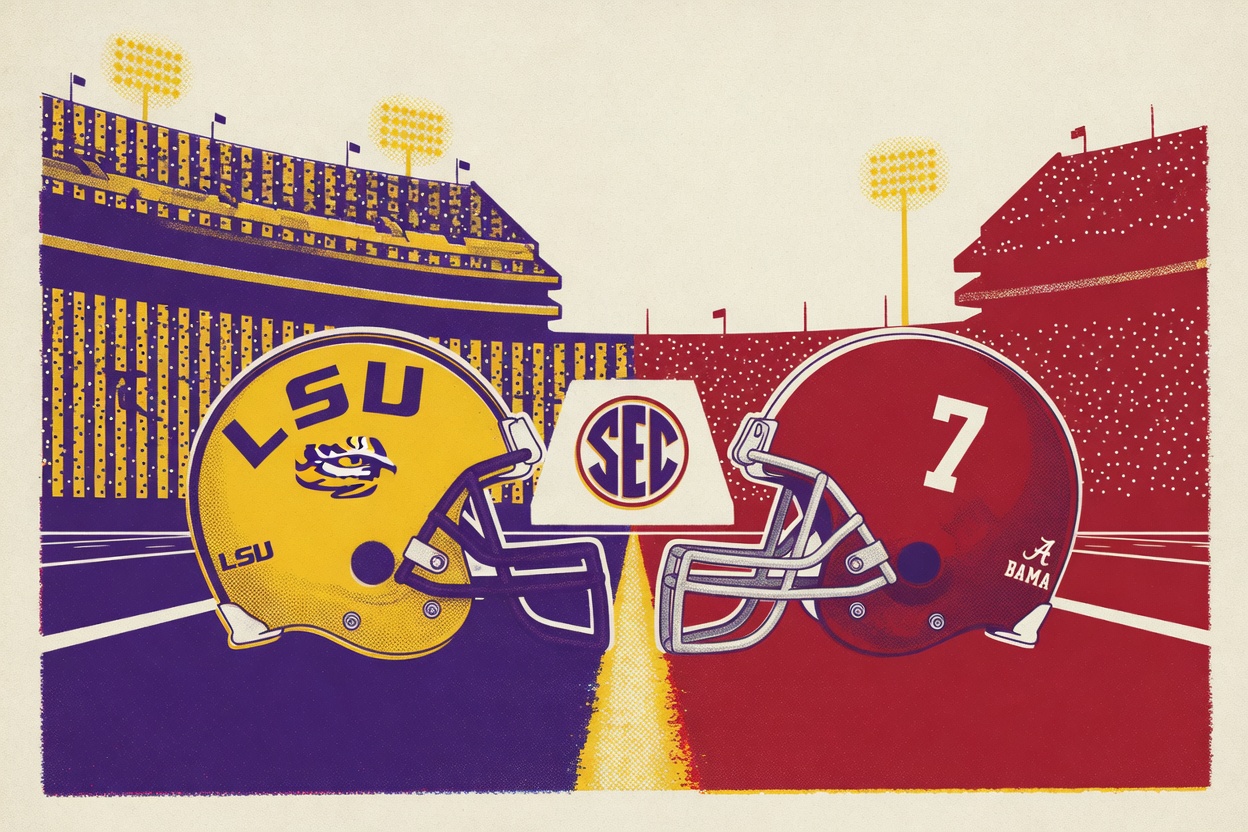
Letting Alabama and LSU stop playing every year is a mistake, and the blame sits with the conference office. Under the SEC's new nine-game schedule, the Tide and Tigers won't meet in 2027, the first time that's happened since 1963. The league had a clean way to prevent it and passed.
The rule explains why. The move to nine conference games came with a "protect three" setup: every team locks in three annual opponents, and the other six rotate. Alabama's three are Auburn, Tennessee, and Mississippi State. LSU's three are Ole Miss, Texas A&M, and Arkansas. Nobody was forced to drop Alabama-LSU. The SEC had the slots, looked at them, and decided Mississippi State was a more important annual date for Alabama than LSU. That's a choice, and it's the wrong one.
Look at what got traded away. Alabama leads the all-time series 58-27-5 and has won the last three meetings, and the two have played every single season since 1964. In 2019, top-ranked LSU beat No. 2 Alabama 46-41 in Tuscaloosa, the kind of game that pulls in people who don't care about either school. You don't put a series like that on a four-year rotation and call it housekeeping. After the 2027 gap, LSU is set to visit Alabama in 2028, there's no game in 2029, and the schedule beyond that isn't settled. That means Alabama isn't booked back into Tiger Stadium until at least 2030. Ask a fan to wait most of a decade for a road trip that used to come around every November.
The root cause is expansion. Texas and Oklahoma joined in 2024, pushing the SEC to 16 teams and blowing up the old scheduling math. Nine games across four years so everyone eventually sees everyone is a reasonable goal. It didn't require feeding the conference's most nationally watched annual matchup into the rotation to get there. The league chose administrative neatness over its best piece of inventory.
Maybe Alabama-LSU lost some shine once Nick Saban left Tuscaloosa, and without Saban on one sideline it's just another good game. Even if the wattage dipped, you don't dismantle a 60-year uninterrupted series on a hunch about one coaching era. Rivalries are the one asset a conference can't go out and buy. Mississippi State is a real opponent with real history, but nobody outside two fan bases is clearing a Saturday for it. The SEC had the marquee game sitting right there and protected the geographic convenience instead.
The coaches didn't drive this decision, and by their own comments they're left defending something they didn't choose. The blame belongs to the schedule-makers in Birmingham, who had the better option in hand and picked the lesser one.