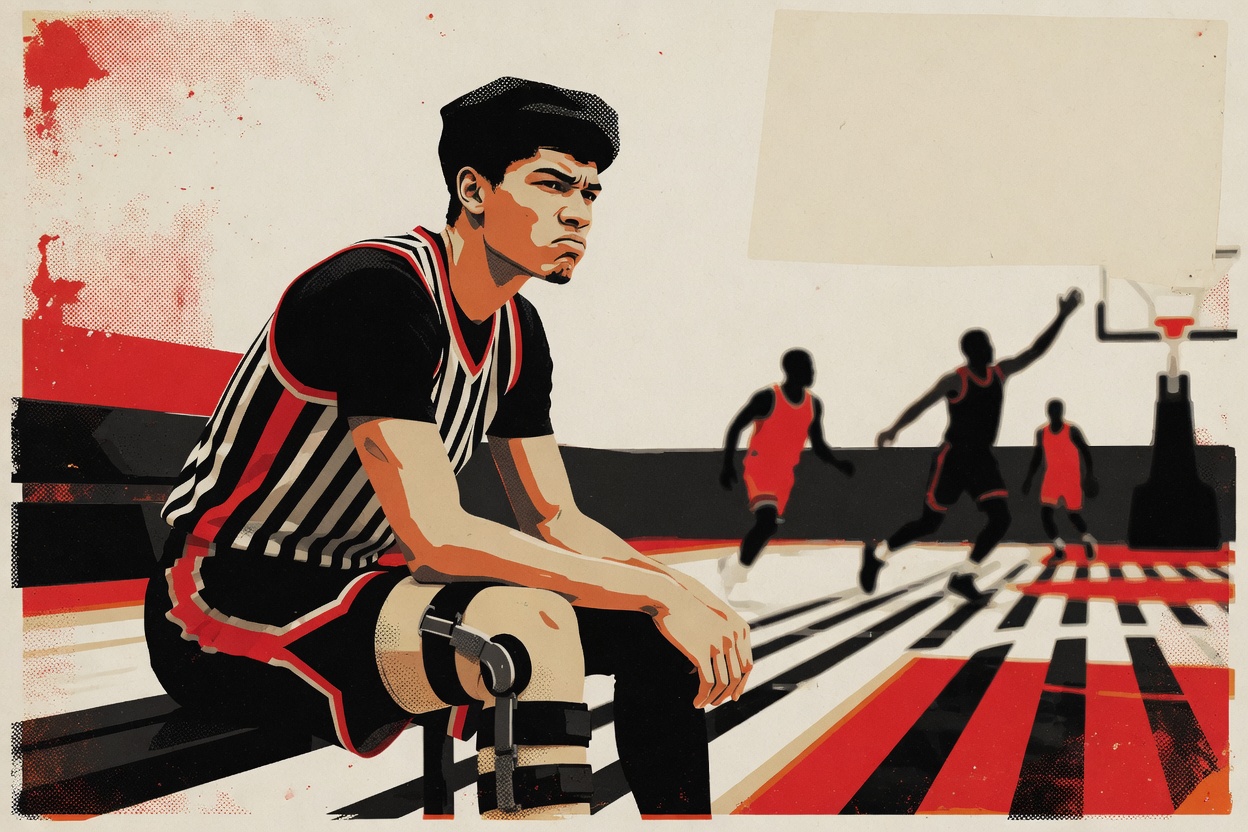
There's a version of this Portland offseason where everything lines up. Damian Lillard comes home and gets whole again, Ja Morant arrives to jolt the offense, and Shaedon Sharpe builds on the best basketball of his young career under a new, cheaper coaching staff. Then this week came word that Sharpe tore the meniscus in his knee during an individual workout. He's expected to have surgery soon and could be out roughly six months.
Six months is a recovery estimate, not a return date, and it deserves to be treated that way. If the timeline holds, Sharpe could be back on the floor in late February or early March, which would leave him a sliver of the regular season and, maybe, a playoff push. But "if the timeline holds" is doing an enormous amount of work in that sentence. For a 23-year-old whose body has already interrupted him more than once, the honest read is that his season is functionally gone before it started.
The money is the story
Last year, Portland locked Sharpe into a four-year, $90 million extension that runs through 2029-30. That works out to roughly $22.5 million a year. By market standards, that wasn't an overpay. Plenty of people around the league thought Sharpe, coming off a career-high scoring season, could have commanded more. The front office read the room, made a reasonable bet on an ascending scorer, and got a deal that looked shrewd the day it was signed.
And it still blew up in their hands. That's the uncomfortable truth about extending young players: you're paying for the next four years based on the last one, and the last one is no guarantee of the next. Sharpe averaged a career-high 20.8 points, 4.3 rebounds and 2.6 assists in 2025-26, exactly the profile you commit to. But that same season he played just 50 games because of a lower-leg stress injury that cost him 28 of them, and his playoff run shrank right along with his minutes: about 13.6 minutes a night in the first round against San Antonio, roughly 7.2 points a game. Go back further and you find a second season derailed by a core muscle injury that required surgery, limiting him to 32 appearances.
So now there are three significant injuries across four pro seasons: the core muscle surgery, the lower-leg stress problem, and now a torn meniscus. They're not the same injury, and a meniscus tear in a workout wasn't predictable. But when you're deciding how much guaranteed money to hand a young guard, durability is part of the math, and Portland's investment keeps colliding with a body that finds new ways to break down.
Two guards, two very different risks
It would be easy, and lazy, to lump this in with the Lillard situation and call it one giant front-office failure. It isn't. Lillard tore his left Achilles on April 27, 2025, in Game 4 of Milwaukee's first-round series against Indiana, and had surgery days later, on May 2. When Milwaukee used the stretch-and-waive provision to move on from him, Portland brought him back on a three-year, $42 million deal. That contract was cheap precisely because everyone knew he'd spend a year recovering. He did exactly that, sitting out all of 2025-26 while the Blazers listed him out for injury management. The risk was known and priced in.
Sharpe is the opposite. Portland handed him $90 million while he was healthy and 23, then watched an injury nobody saw coming land right after the ink dried. One was a calculated discount on a known problem. The other is a bolt from the blue hitting a fresh, full-price commitment. Both are real, and lumping them together muddies the point.
What matters is this: Portland has now committed serious money and serious hope to a backcourt where its two most important pieces are both question marks heading into a season that tips off October 21. Lillard turned 36 in mid-July, and while the team has pointed toward him being ready for opening night, outside medical voices have noted that Achilles recoveries for guards in their mid-30s often take 12 to 18 months to fully restore explosiveness. That's a target, not a promise, and now Sharpe's timetable sits next to it as one more thing that has to break right.
A silver lining, and a bigger cloud
There's a counterpoint worth acknowledging. The Blazers had already built a crowded backcourt this summer, adding Morant to a group that also includes Lillard, Jrue Holiday and Scoot Henderson. As Spotrac's Keith Smith put it, the one bit of consolation is that they "already projected to have a crowded backcourt." Sharpe's absence eases a minutes crunch that was going to be awkward anyway. Fine. That's a real basketball observation.
It doesn't change the money, though. You don't feel better about paying a player who can't play just because you happened to be overstocked at his position. And it lands inside a broader front-office picture that's already drawing skeptical looks: new owner Tom Dundon's cost-cutting and arena fight have hung over an otherwise encouraging season in which Portland went 42-40 and reached the playoffs for the first time since 2021. The Blazers were the only team to skip June's draft entirely, and the hire of Micah Nori on an unconventional year-to-year deal has been read by some as the cheap option rather than the committed one.
Add it up and you have a team that made a genuinely good on-court leap, then spent the offseason giving people reasons to wonder whether the people in charge are building or just balancing a spreadsheet. The Sharpe injury isn't their fault. But it's a brutal test of a plan that needed a lot of things to go right, and it's the kind of luck that separates organizations with margin for error from organizations without it. Portland doesn't have much margin, and this season just used up a big chunk of it before the first tip.