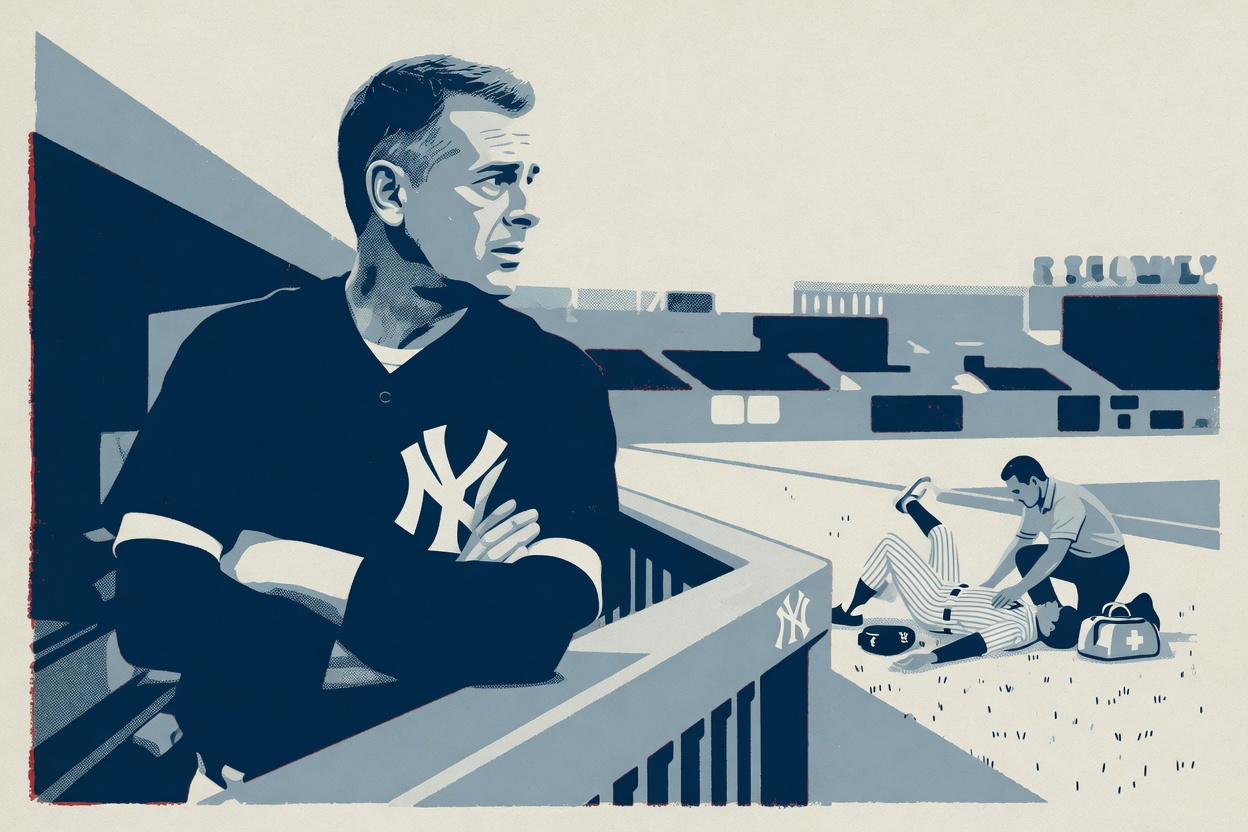
There's a version of this story where a center fielder pulls up lame in September and nobody notices, because the contender built a real bridge behind its regulars. That's not the Yankees. When Trent Grisham grabbed his right hamstring on Friday and landed on the 10-day injured list the next day, the Yankees lost more than an everyday outfielder. They ran into a shortage they'd been pretending wasn't there.
What actually happened
Grisham tweaked the hamstring in Friday's game, unable to reach a ball Xander Bogaerts dropped in front of him, and left an inning later. By Sunday, Aaron Boone had the harder news: a Grade 2 right hamstring strain, no firm timetable, and Grisham could be done for the rest of the regular season. Boone said Sunday that Grisham was moving well right away, which he called a good sign. But with the season running down and a Grade 2 strain being a partial tear, even an optimistic recovery eats most of what's left.
Worse, it's the same hamstring. Grisham strained it in mid-June and missed nearly three weeks then. A soft-tissue injury that comes back in the same leg isn't one you rush in a playoff race.
The depth that was never there
The uncomfortable part, and this is my read, not the team's: the Yankees didn't have a real center-field answer even before Friday. With Aaron Judge working back toward a return, the Yankees were already staring at an outfield crunch that had Spencer Jones potentially headed to the minors. A crunch is a problem you'd love to have. Now it's flipped into a shortage. Jones looks likely to slide from a corner over to primary center field, with Heliot Ramos and the recalled Jasson Domínguez picking up corner reps, and all of that gets squeezed again once Judge is back in the lineup.
That isn't depth. It's players getting reshuffled to cover a hole nobody planned for.
This offense has been surviving on fumes anyway. Judge has been out since May 31 with a stress fracture in his right rib, best-case return targeted for the second week of September, and during his absence the Yankees ranked 28th in runs, 28th in OPS, 29th in wRC+ and 30th in batting average. Giancarlo Stanton (calf) and Oswaldo Cruz (elbow) have both been moved to the 60-day IL, taking two more corner/DH-type bats off the board for the stretch. This is a lineup with no margin, and it just lost another body.
Grisham wasn't exactly carrying the offense. The 29-year-old was hitting .211/.308/.395 this year, a real step back from the career year that produced 34 home runs and an .812 OPS. But a healthy, defensively capable center fielder is worth a lot more in September than his slash line suggests when the alternative is stacking corner outfielders out of position.
The deadline is the real culprit
At the August deadline, the Yankees' outfield move was Ramos, a right-handed hitter acquired from the Giants specifically because they needed help against lefties, and he's one of the better outfield bats against them. Fine, useful, but not a center fielder. Their other offensive add was first baseman Luis García Jr., who cost four pitchers, including Jake Bird and Yovanny Cruz, which thinned an already overworked bullpen.
CBS Sports called the approach what it looked like: three obvious needs going in (a righty-hitting catcher, a righty-hitting outfielder, and bullpen help), one addressed. Yahoo noted the Yankees weren't aggressive while the AL East got tougher around them, with the first-place Rays landing starter Freddy Peralta. There's a real counterargument, though: ESPN's roundtable called the deadline a net positive given a soft AL field, since the Yankees added the National League's slugging leader in García and a controllable outfielder in Ramos without giving up their best prospects. Reasonable people disagree on the overall grade.
But even the forgiving takes concede the bullpen and catcher went unaddressed, and none of them claimed the Yankees added outfield insurance. Ramos was a matchup piece, not a break-glass center fielder. So when the one everyday center fielder went down with a recurring injury, there was nothing behind him except position shuffling. That's the bill coming due for a quiet August.
What's at stake
The Yankees sit first in the AL Wild Card, three games up on Boston after taking three of four from the Red Sox Aug. 28-30 to lock up a season tiebreaker. This isn't a doomsday piece. They're in playoff position right now, with roughly three weeks left. The Rays lead the division and would hold the tiebreaker barring a four-game sweep in the Bronx from Sept. 22-24, so the realistic path is holding a Wild Card slot rather than chasing down Tampa Bay.
A three-game cushion in September is comfortable until it isn't, especially for a lineup already grading out near the bottom of the league without Judge. Judge's return, whenever it fully arrives, changes the ceiling. It does not change the fact that behind the stars, this roster is one hamstring deep, and now that one hamstring is gone. If the Yankees slip out of the picture over the next three weeks, the tape won't only show Grisham grabbing his leg. It'll show a front office that had a month to build a floor and chose not to.