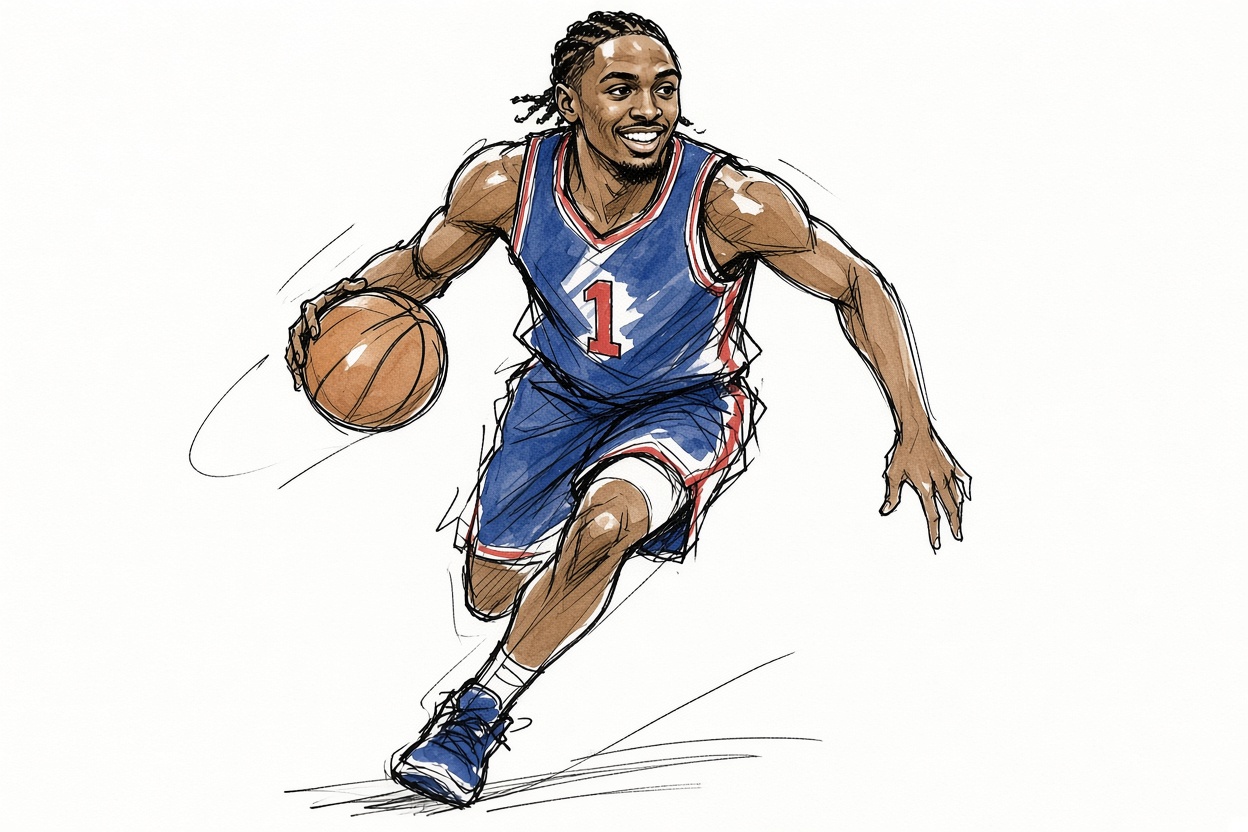
If the gather rule means anything, Tyrese Maxey traveled, and the crew working Monday night in Brooklyn missed it.
Start with what the rule actually says, because nobody can argue with this part. Once a player gathers the ball, the NBA gives him two steps. Two. That's the whole boundary. It applies whether he's finishing a drive or coasting in off a steal. The league even rewrote the language recently to tighten enforcement, closing the gap between the rule as written and how it gets called. The limit is still two.
Now the play. On the Nets' opening possession, Maxey picked off a Michael Porter Jr. pass, took two dribbles, and coasted in for an uncontested dunk to open the scoring. On the way to the rim he took considerably more than the rule allows, and no whistle came. The game kept going. Philadelphia kept scoring.

 Rating
 Rating
That's the violation. It isn't complicated, and it doesn't need a slow-motion replay to see.
None of this is on Maxey. He did what every competitor does when officials let him play through it. Nobody stops mid-dunk to call himself for a travel. Hand a guard an extra step with no consequence and he'll take it, every time, and finish the play. The responsibility sits with the three people paid to enforce the boundary in real time, and on this possession they didn't.
RTGThe rule itself is fine, specific even, whatever the lazy conclusion some people jump to. Enforcement is what's broken, and the league's own people keep admitting it after the fact instead of in the moment.
Look at the recent record. When LaMelo Ball got away with a stepback in Minnesota's opener, the NBA Referees Association came out the next morning and said flatly that he takes four steps after gathering the ball and travels. The same body flagged a preseason sequence where Hugo González took five steps before an uncontested layup with no call. Two public walk-backs in the span of a month, both on exactly the kind of highlight play the camera loves.
Maxey has lived this before, too. In a 2024 playoff game against the Knicks, the NBA's own Last Two-Minute Report said his four-point play should have been wiped out for traveling, noting he moved his right foot again after taking two legal steps. Almost nobody flagged it in real time. That was a far bigger moment than an opening-possession dunk, and the league still only caught it on paper, after the fact.
This is bigger than one guard in one game. A boundary that only gets enforced after the fact, in a tweet or a report that diehards read and nobody else does, is just a polite request. The two-step limit either exists on the floor, called by the people holding the whistle, or it exists only in the rulebook and the apology emails.
This is about watching a written rule get ignored in plain sight, then confirmed as ignored the next day, over and over, until fans stop trusting that the line means anything. The league can't keep conceding travels in writing and act surprised when people start asking whether the rulebook is real.
So pick a lane. Enforce the gather as written, in real time, and live with a few whistled highlights. Or admit the two-step limit is decorative and change the rule to legalize what star guards are already getting away with. What the league can't keep doing is pretend the boundary holds while its own referees keep telling us, a morning too late, that it didn't.