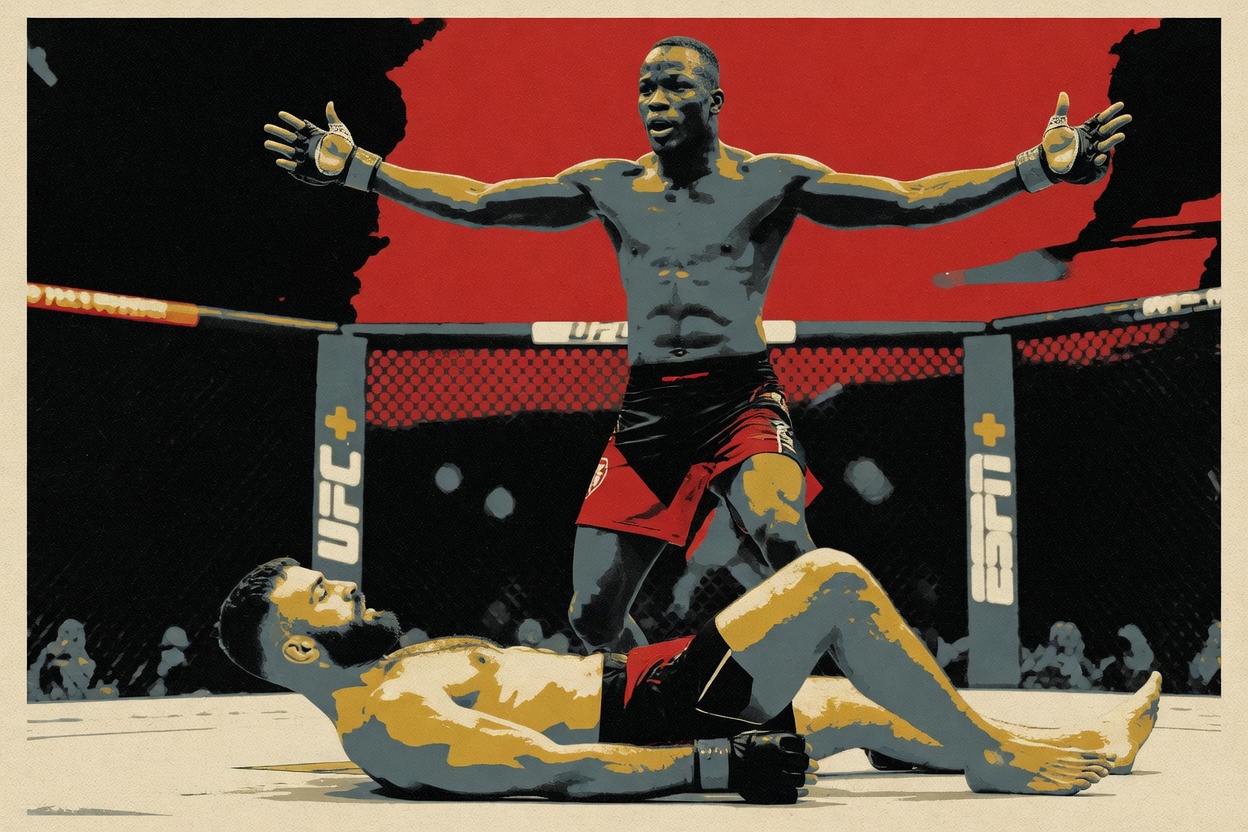
Toughness is the sport, no argument there. Fighters walk into a cage knowing what they signed up for, and Alonzo Menifield winning a fight with his thumb bone poking through the skin is a story people will replay for years. Salute the man. He's a warrior.
But separate the fighter from the system that's supposed to protect him. What should keep you up at night after UFC 331 isn't Menifield's pain tolerance. It's the clock.
The reporting from that night lines up. Menifield hurt his thumb in the first round against previously undefeated prospect Iwo Baraniewski, and he confirmed it afterward. Bloody Elbow described him gripping a thumb that looked completely displaced, bone through the skin, at the end of that opening round. Yahoo Sports called it a total compound fracture of his left thumb. The deformity was visible before round two even started.
Yet the first formal medical check didn't happen until the break between rounds two and three. Yardbarker had the cageside doctors examining the injury as round three was about to begin, then clearing him to continue. Sherdog's account matches it: the doctor came in at the end of the second round, the thumb was bleeding heavily, and Menifield was waved on.
Run that timeline back: a bone was through the skin at the end of round one, and a doctor didn't look at it until an entire round later. That's not a gray area. It's a window where a fighter competed with a compound fracture and nobody with a stethoscope got close enough to see it.
My take is simple: this deserves scrutiny. "He won, so who cares" is the wrong way to file it away.
Know what a compound fracture actually is. It's not a rolled ankle or a fat lip. When bone breaches skin, you've got an open wound and a path for infection, on a hand that's being slammed into another person over and over. Menifield went for precautionary X-rays and, along with Pantoja, got taken to a local hospital afterward. The UFC called both trips precautionary. Fine. But if the injury was serious enough for a hospital that night, it was serious enough for a doctor to be standing over him the moment it happened, not a round and a half later.
I'm not saying stop the fight. That's a call I'll leave to the people who examined the thumb. I'm saying the exam should have come sooner. The delay is the issue, not the outcome. A fighter shouldn't be able to bleed through the better part of two rounds on a broken bone that's visibly out of his hand before the medical staff catches up to what everyone watching already saw.
This wasn't a quiet injury nobody noticed. Dana White later shared images of it himself. If it was graphic enough for the boss to post, it was graphic enough to warrant a look at the first break. The broadcast crew, the cameras, and the audience all saw it. The one group that took longest to get involved was the one whose entire job is getting involved.
None of this takes away from what Menifield pulled off. He fought all fifteen minutes and took a split decision, scored 29-28, 29-28, 28-29, over a previously undefeated opponent. That's a genuinely great win, and he earned every bit of the reaction. The point isn't to shrink his moment. It's to make sure the next guy in that spot gets checked before round two instead of after it.
Meanwhile the main event gave the night its other hospital story. Alexandre Pantoja, a former flyweight champion, lost a clear unanimous decision to Joshua Van in their title rematch, with cards landing in the neighborhood of 49-46 and 50-45. Van outstruck him, stopped a string of takedown attempts, and dropped him in the fifth. Pantoja was taken for precautionary CT scans afterward. This was the first time in his long career that he's lost two in a row, a rough turn for a man who at one point won eight straight and defended the belt four times. Two big names, two hospital trips, one night. The UFC called both precautionary. I'll take them at their word on the medicine.
What I won't do is pretend the sequence with Menifield's thumb was normal or acceptable. This is a developing story, and it's fair to wait on whatever review the promotion and the athletic commission run. But the basic facts we have now are enough to ask the question loudly: if a bone through the skin doesn't trigger an immediate doctor's visit, what does? A great sport can be tough on its athletes and still owe them a system that reacts in seconds, not rounds.