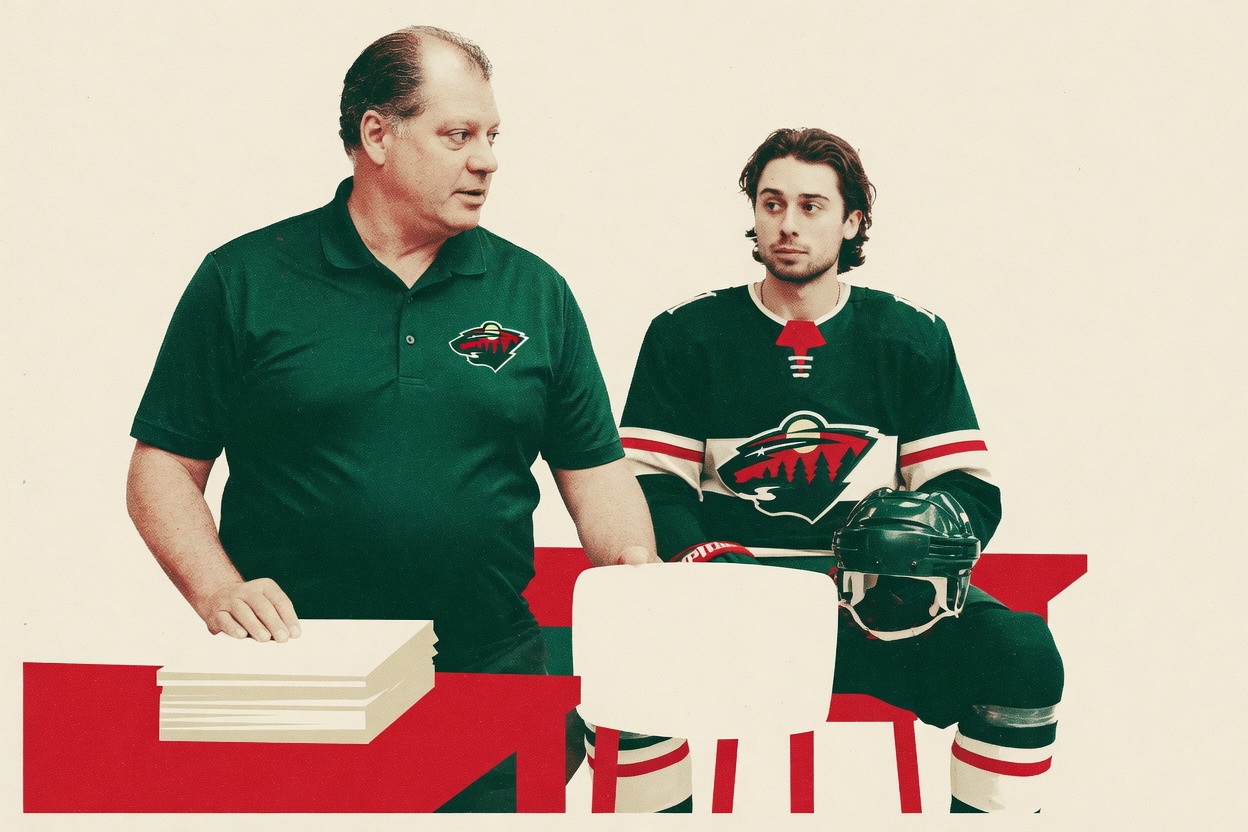
There are front-office decisions that require a spreadsheet and a stiff drink, and there are ones you make with your eyes closed. Handing Bill Guerin a multiyear extension falls in the second category. The Minnesota Wild did it this offseason. The team hasn't formally announced it and the terms aren't public, but the logic doesn't need terms to hold up.
Start with what he's actually done. Guerin is the reigning winner of the Jim Gregory Award as NHL General Manager of the Year, voted on by his peers and a panel of executives and media, which he collected in June after a 104-point season. He enters his eighth season running Minnesota's hockey operations, the man brought in to replace Paul Fenton after a long playing career and five years as an assistant GM in Pittsburgh. This is a paycheck for results already delivered, not a coronation of potential.
And the results are loud. Last season Guerin watched the Wild win a playoff series for the first time in more than a decade, beating Dallas in six games in the first round, before the run ended with a five-game second-round loss to Colorado in mid-May. That fits the franchise's stubborn shape: Minnesota has reached the playoffs in 12 of the past 14 seasons and still hasn't gotten past the second round. But Guerin has spent the last year swinging at that ceiling instead of admiring it.
He gave Kirill Kaprizov an eight-year, $136 million contract, the richest deal in NHL history at the time it was signed. Then, in December, he made one of the boldest trades the franchise has ever attempted, sending Marco Rossi, Liam Ohgren, Zeev Buium and a 2026 first-round pick to Vancouver for Quinn Hughes, the 2024 Norris Trophy winner. ESPN described the cost as the equivalent of four first-rounders, and even Canucks GM Patrik Allvin didn't pretend it was painless: "It's definitely not an easy day for the franchise," he said. In between all of it, Guerin ran the U.S. men's team that won Olympic gold in Milan, the country's first since 1980. Minnesota also extended coach John Hynes, who enters his fourth season, ahead of camp. A stable, ambitious operation rewarding the person who built it. Nothing to argue with there.
The extension is the easy headline. The real test of Guerin's front office is the thing sitting quietly in the corner of training camp. Quinn Hughes reported without a new contract, entering the final year of his current deal, and that's the storyline that will define this era in Minnesota far more than any piece of paper Guerin signed for himself.
The clock has already cost the Wild something. Under the league's new CBA, an eight-year extension was only available if Hughes signed before the agreement kicked in around mid-September. That window closed. He can still sign for up to seven years, and a deal at the maximum could reach $20.8 million per season, but the longest possible term with a generational defenseman is already off the table. When you trade the equivalent of four first-rounders for a player, losing a year of control before you've even signed him isn't a rounding error.
This isn't a standoff, at least not yet. Hughes has gone out of his way to lower the flame. "I have so much trust in Billy," he said. "He's a great GM. He's always going to address the needs of the team. It's not like I have to freaking poke at Billy to do something." He's also said flatly, "I don't feel stressed to do something before the season." That's a player who isn't picking a fight. It's also, if you're Guerin, exactly the kind of calm that can curdle into a distraction if a signature doesn't arrive.
The subplots are already forming. There's persistent speculation, treated by league sources as informed guesswork rather than a stated plan, that Hughes might prefer a shorter term, something like three years, to line himself up with his brothers Jack and Luke in New Jersey around the time Jack reaches free agency in 2030. Nobody has confirmed that's what Hughes wants, and he hasn't put a preferred number on it. But the theory exists, and every week without a deal gives it more oxygen. That's how a non-story becomes the only story by the deadline.
There's also the practical risk nobody likes to say out loud. One estimate pegged the potential cost of an injury during camp, with no extension in place, at north of $50 million to Hughes personally. Treat that figure as a back-of-the-napkin projection, not gospel, but the principle is real: "no rush" is a comfortable posture right up until something goes wrong on the ice.
Even Guerin's success stories have gotten tense. Before Kaprizov landed his record deal, he and his agent turned down an earlier offer. Getting the biggest contract in the sport done didn't mean it was smooth. Hughes has been more publicly relaxed than that, which is a gift, but it doesn't change the assignment.
The extension and the negotiation belong to the same argument. You reward the GM who went all-in on a win-now roster, and the next thing you ask him to do is finish the sentence. The Wild open the season October 1 at Nashville. Guerin has bought himself time and job security. What he hasn't bought yet is the one thing that trade was supposed to guarantee: Quinn Hughes, in Minnesota, for a long time. Until that's signed, the boldest move in franchise history is still a lease, not a purchase.