There's a version of this Anaheim summer that looks like ambition: the Ducks matched a $90 million offer sheet to keep a young center, went hunting for scoring depth in free agency, and built around a core that finally has a pulse. There's another version, the one Pat Verbeek is actually living in, where every one of those moves narrowed the room he now needs to sign his best goal-scorer.
In mid-August, word broke that restricted free agent Cutter Gauthier turned down a four-year, $52 million offer from the Ducks, an average of $13 million a season. One caveat: the report traces back to a single insider, Paul Shaheen of NHL Network Radio. Other outlets have repeated it since, but Anaheim hasn't confirmed anything, and The Hockey News itself flagged the sourcing as shaky. Call it strong reporting, not gospel. The math behind it holds up regardless of the exact number.
The corner Verbeek built
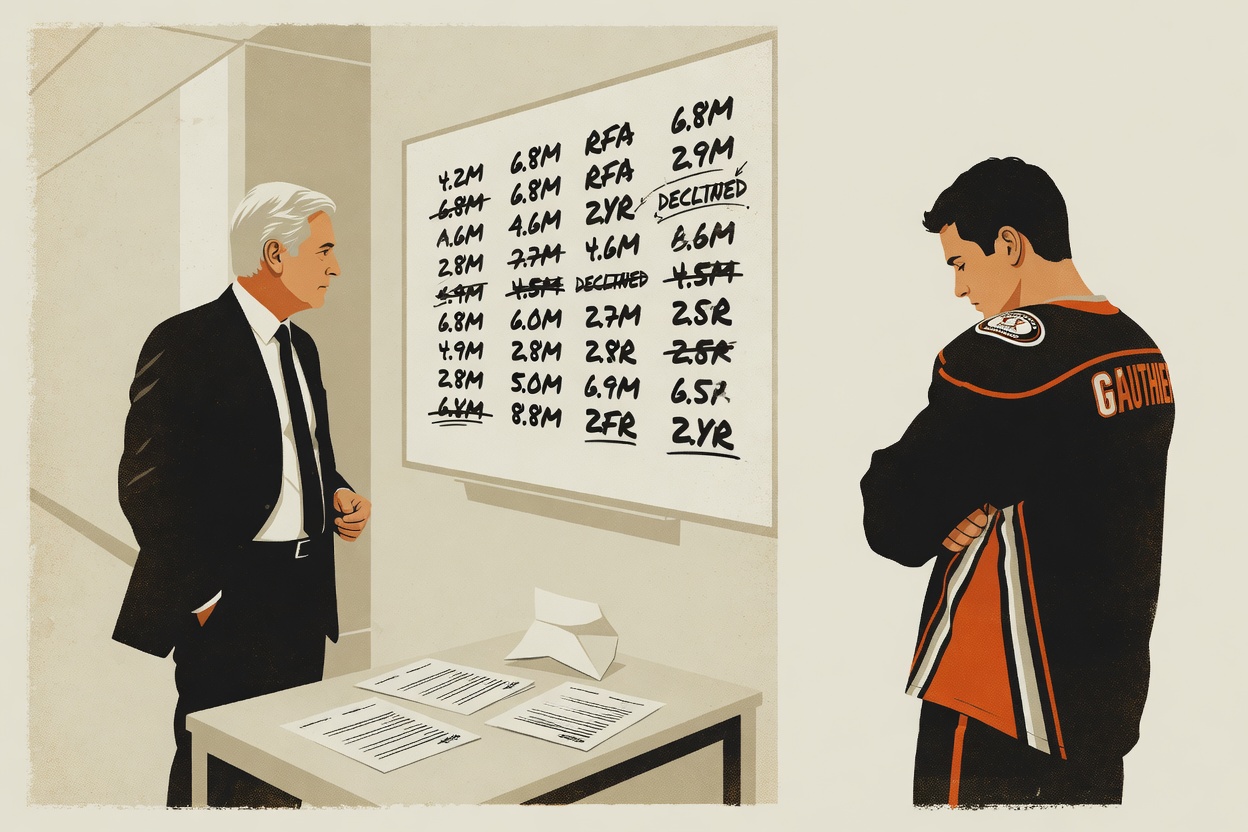
Start with the cap sheet. Anaheim is working with roughly $9.07 million in projected space. A $13 million contract doesn't fit inside $9.07 million. It wouldn't fit even if Gauthier's camp came all the way down, because the reported range for what he wants sits higher, somewhere in Connor Bedard territory around $15 million, with one single-sourced rumor floating $16 to $17 million. Whatever the true figure, there's no version where Verbeek signs this player without subtracting salary somewhere else first.
That's the part worth sitting with, because it wasn't inevitable. This is the same front office that matched Philadelphia's five-year, $90 million offer sheet for Leo Carlsson in early July, choosing $18 million a year on the books over the four first-round picks Anaheim would have collected as compensation had they walked away. Matching was defensible on hockey terms. Carlsson is a foundational center. But you don't get to make that call and then act surprised when the next young star's number becomes a problem.
And the Carlsson saga didn't arrive out of nowhere. Verbeek's reputation as a hard negotiator is well earned, and this summer the approach seems to have curdled. A year of talks with Carlsson went nowhere until Philadelphia forced the issue with an offer sheet. Elliotte Friedman, on the 32 Thoughts podcast after the match, put it plainly: "I don't think (the Ducks) thought it was going to go here." That's a front office reacting to events rather than steering them.
The smaller signings sharpen the point. Nobody made Anaheim commit almost $4.6 million against the cap to Frank Vatrano, or spend a combined $8 million this summer on AJ Greer and Ryan Poehling. Each move is minor on its own. Stacked together, they're the difference between having comfortable room for Gauthier and needing a fire sale to create it.
Why Gauthier holds the cards
The irony here: the player Anaheim can least afford to squeeze is the one with the least conventional leverage. That may not matter.
Gauthier is coming off his entry-level deal without arbitration rights, and unlike Carlsson he's ineligible to sign an offer sheet because he hasn't logged enough service time, which makes him a 10.2(c) restricted free agent. His only real options are to re-sign in Anaheim or sit out. That's the Ducks' best argument, and they'll lean on it hard: the Bedard comparison actually cuts in their favor, because Bedard and Carlsson had paths to walk that Gauthier does not.
Except a comparison is only as good as the player's willingness to blink, and this is a player who has already shown he won't. He was the fifth pick in the 2022 draft, and he made it clear he wouldn't play for Philadelphia, refusing to meet with the Flyers' front office until they moved him to Anaheim for Jamie Drysdale and a 2025 second-round pick in January 2024. Daniel Briere said Gauthier had signaled his unwillingness as early as the previous spring. Whatever you think of that, this isn't a 22-year-old who folds just because the CBA says he should.
He's got the season to back the stance, too. Gauthier led the Ducks in scoring last year, the kind of season that turns a negotiation into a standoff.
The December clock and the veterans on the block
The deadline is what turns this from a staring contest into something with a body count. If Gauthier doesn't sign before December 1, he becomes ineligible to play the rest of the 2026-27 season, including the playoffs, even if he signs afterward. Verbeek is negotiating against a calendar as much as a number, and he has to get the roster cap-compliant to make room.
That brings us to the veterans. Multiple outlets have independently landed on the same two names as the logical salary to move: Chris Kreider at a $6.5 million cap hit and Alex Killorn at $6.25 million, both in the final year of their deals. To be clear, this is informed speculation, not a reported shopping effort by the Ducks. But the logic writes itself. Moving either one without retaining salary would open enough space to get a Gauthier deal done, and both are the kind of expiring contracts a contender might absorb.
My read: this is the bill for a summer of playing everyone tough at once. Verbeek can still get Gauthier signed, and probably will, because losing a scorer of that caliber to a season-long holdout is an outcome no front office survives cleanly. But the price won't only be dollars to Gauthier. A useful veteran will likely get shipped out the door too, to pay for a problem Anaheim helped create. That's what happens when the hard line works on nobody and the cap comes due all at once.