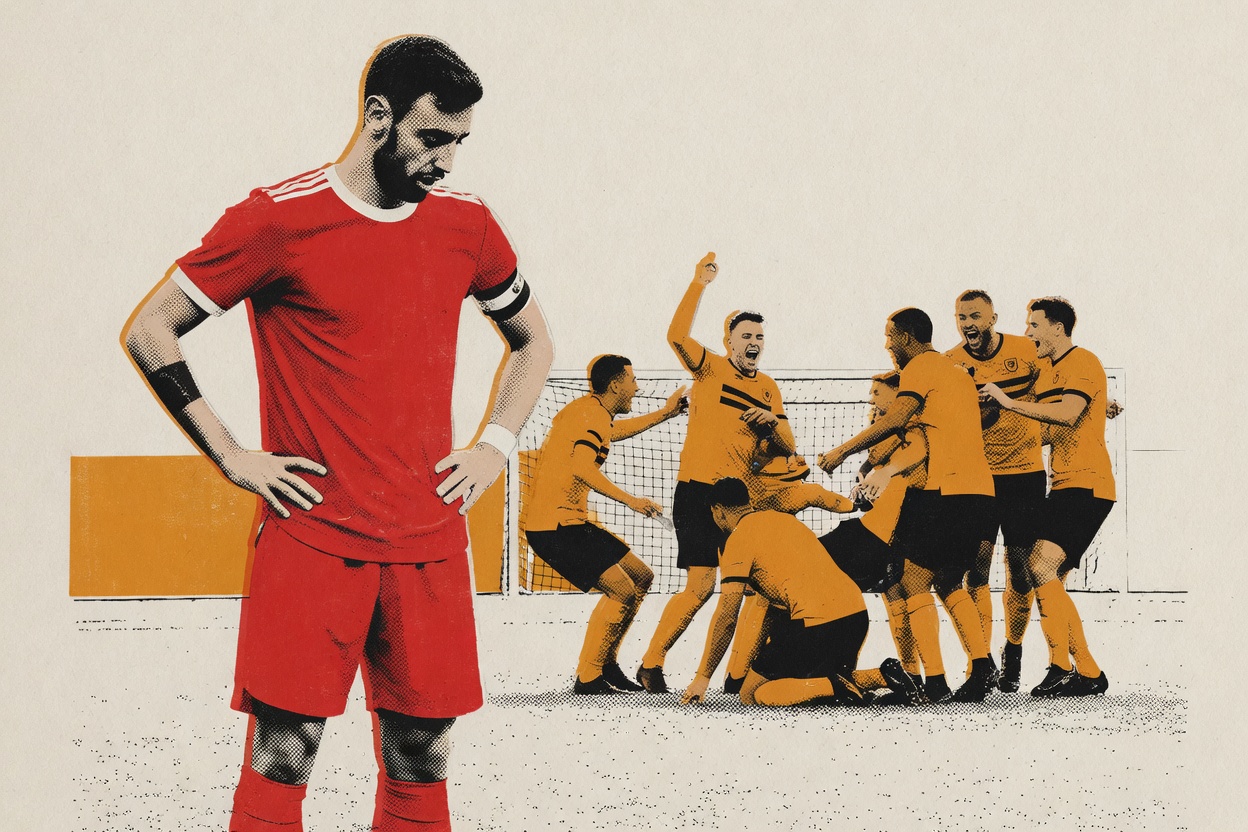
Manchester United spent the summer selling a story about progress: a strong finish to last season, Champions League qualification, a manager in Michael Carrick who'd earned the right to be judged on more than potential. Then Hull City, back in the Premier League for the first time in nine years, worked a set piece in the 17th minute, and by halftime that story had a hole in it.
Both Hull goals came from dead balls. Regan Slater's corner caused chaos that Oli McBurnie's header turned into a rebound, and Semi Ajayi poked it home. Then Slater found the back post from a free kick and Nobel Mendy headed in the second before the break. Both goals from set pieces, in the same half. That should worry United more than the scoreline itself.
The individual moments, a deflection, a lost header at the back post, are forgivable on their own. What isn't forgivable, if you're serious about building something at Old Trafford, is getting undone twice in the same half by the same kind of delivery. Bruno Fernandes said as much himself, pointing to the physicality and intensity of a promoted side playing at home and admitting the two set pieces decided the game. When your captain names the exact tactical failure in real time, that's not deflection, that's diagnosis, and an uncomfortable one for a coaching staff that had all preseason to drill it.
What happened after halftime is almost more damning than the goals themselves. United had the ball and the territory, and nothing to show for it. Marcus Rashford came on for the booked Patrick Dorgu, and United's only real second-half chance fell to Bryan Mbeumo, saved by Hull keeper Konstantinos Tzolakis, who had the game of his life at the other end. A team that dominates possession against a newly promoted side and can't force more than one clean look has more than a finishing problem. It's missing ideas. That's my read on it, not a stated fact from anyone in the building, but it lines up with what was visible on the pitch.
Carrick, for his part, struck the only tone a manager can strike in August: calm and insistent that one match won't derail a long-term project. He's right that a single opening-day defeat shouldn't be treated as a crisis, and on the same weekend Arsenal put three past another promoted side without blinking, a useful reminder that Hull's result says as much about Hull's ambush as it does about United's malaise. Promoted sides playing their first Premier League home game in years, in front of a crowd that's waited nine years for this, are supposed to be dangerous. That doesn't excuse United, but it explains some of it.
But context isn't the same as absolution. If United concede from two set pieces on their next difficult away trip, or against a side with real physical presence, the conversation stops being about one bad afternoon and starts being about a structural problem Carrick hasn't solved. He says it won't knock his side off course. Fair enough. The next few matches will tell us whether that course was ever fixed in the first place.