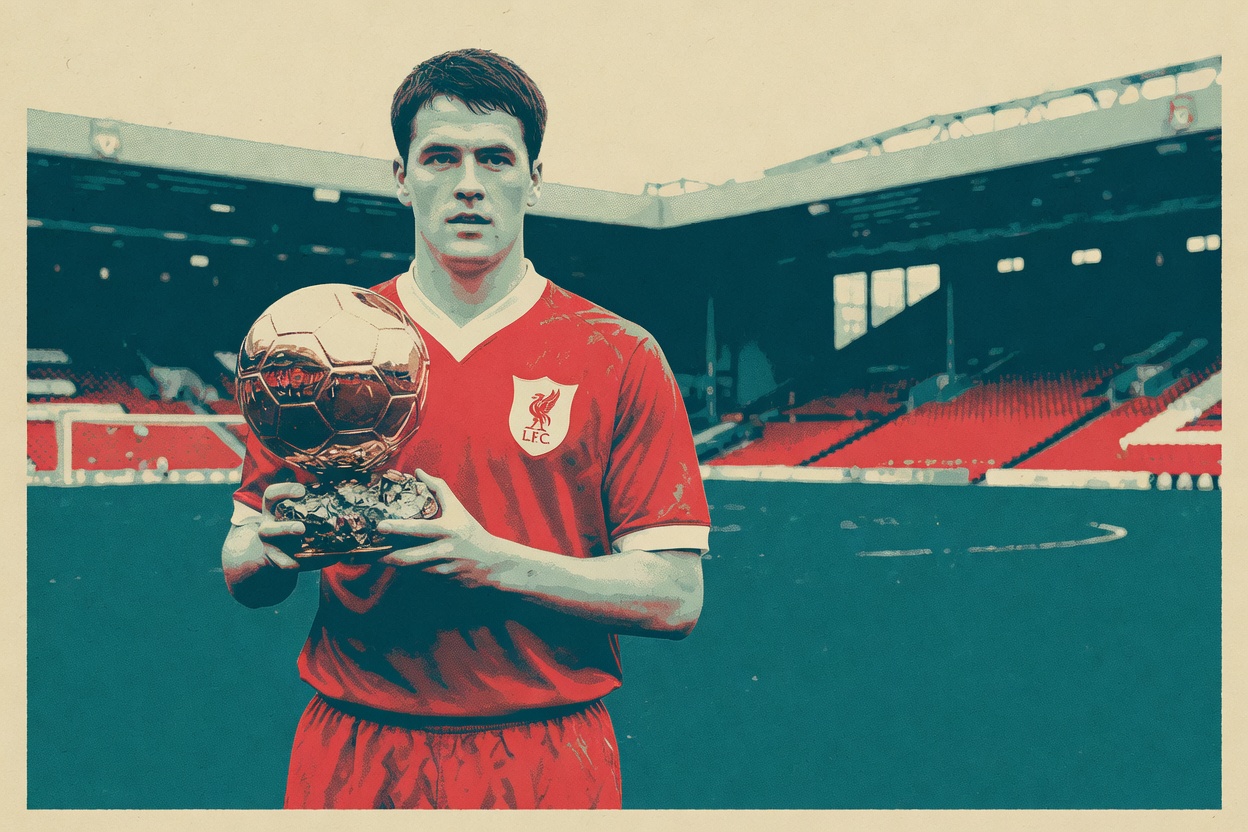
Michael Owen is right. English football undersold his 2001 Ballon d'Or in real time, and you don't need his word for it. You just need to look at how they handed the thing over.
The award came to him on the Anfield pitch the following April, just a quick handshake a few minutes before a league game against Derby, which Liverpool won 2-0 with Owen scoring twice. That was the full celebration for the best player in Europe: a midweek crowd, two goals, then back to the dressing room.
Now put that next to what Harry Kane walked into on Monday. The Palladium, the cameras, the first English winner in 25 years, feted for a season in which he scored 73 goals for club and country and captained England to third at the World Cup. Owen opened the 25-year gap that Kane just closed, and the two of them got treated like they won different trophies. In a sense they did, because England decided one mattered and the other didn't.
The list of names Owen beat is the part nobody wants to sit with. He took it with 176 points, 36 clear of Raúl in second, with Oliver Kahn, David Beckham, Francesco Totti, Luís Figo, Rivaldo, Andriy Shevchenko, Thierry Henry and Zinedine Zidane all stacked up behind him. He won it comfortably, three days after turning 22, in a year when Liverpool collected six trophies. Call it a quirky European award if you like, voted on by UEFA-nation journalists before the whole circus went global. It was still the best player in Europe, and that year the best player in Europe was a 22-year-old from Chester.
There's a catch, though. The same calendar year, FIFA's own World Player of the Year vote put Owen eighth, with Figo first, Beckham second and Raúl third. That's real, and at the time plenty of people in England treated the FIFA prize as the serious one. It handed every pundit a ready-made shrug: the Ballon d'Or was the odd result, the FIFA list was the true verdict, and Owen could be filed under promising young striker. A player who wins one award in a landslide and finishes a distant eighth in another the same year never gets a clean, unarguable coronation. That split is a big reason the achievement never carried the weight it should have.
The credit gap isn't all England's doing. Owen bears more of it than he lets on. He went to Real Madrid, and it didn't take, a gamble that didn't land. Then he came back, joined Newcastle, and eventually pulled on a Manchester United shirt. Jamie Carragher put it as plainly as anyone can: "Going to Real Madrid didn't go down very well, then when he came back to England and joined Newcastle, it was a surprise. But it was signing for Manchester United that really severed all ties."
Fans are tribal. They remember who you played for last more than who you were at 22. You cannot spend years in United red and then expect Liverpool to keep a candle burning for what you did in their shirt. Carragher, who clearly rates him, gets why Owen's frustrated: "I can understand why he gets so frustrated, because he probably sees players spoken of a lot more fondly when they didn't put in half the work he did." Both things are true: Owen did the work, and he also torched the one fanbase that would have carried the legend for him.
Owen says it's never been that important in England, and that in Spain they treated him like a hero. He's right about the first part and he's got a fair grievance about the second. The treble year, the Ballon d'Or, the list of names he beat, all of it deserved more than a handshake before a Derby game. But he's wrong to act as if the culture did all of this to him. He took the biggest individual honour a Liverpool player had won in a generation and then handed the memory of it over to a rivalry he chose to join. He was shortchanged, but he helped write that cheque too.