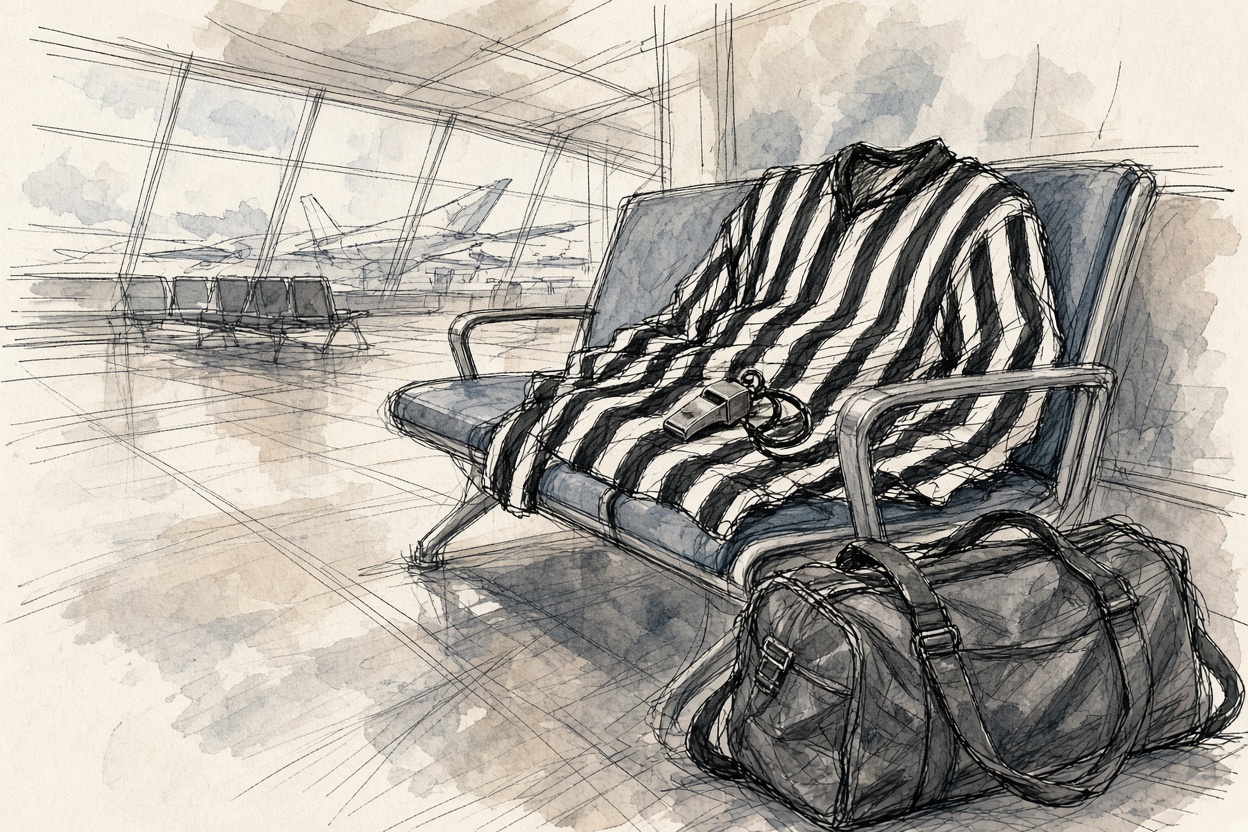
Hockey spent Saturday arguing about a simple question: if the officials can't get to the building, what happens to the game?
The answer, straight from the NHL's own rulebook, is almost funny for a league this rich. Rule 31.11 says that if the appointed referees and linesmen can't appear and the league can't find replacements, the two head coaches are supposed to just agree on who works the game. If they can't agree, each team hands a player a whistle, the home club's guy playing referee and the visiting club's guy on the lines. That is a real, written rule. It has actually happened, with a linesman taking over referee duties and each side dressing a player until the regular crew showed up. So games can proceed. The contingency exists.
That it exists at all is the embarrassing part, and this one's on the NHL.
The league didn't cause Friday's mess. The nationwide ground stop was a federal failure: transportation officials blamed outdated air traffic control communications equipment that overloaded and went down, and said clearly it wasn't a cyberattack. The FAA grounded every U.S. departure, commercial and private, for hours before lifting the stop Friday night. Thousands of flights were delayed, thousands more canceled. That mess belongs to the FAA and whoever's been slow to modernize that equipment.
What the NHL owns is what came next. Bruce Garrioch pointed out early Saturday what everyone in the sport already knew: NHL officials fly commercial, teams can't play without them, and as of his post it was unknown whether the crews were caught up in the disruption. Fourteen games were on the board. The players flew charter. The equipment flew charter. The people whose entire job is to stand on the ice at a fixed time in a fixed city were left hoping an airline cooperated.
That's a choice. The league has made it and re-made it every offseason it didn't fix it. A league quick to discipline coaches over their treatment of officials apparently doesn't value those same officials enough to guarantee they can reliably show up for work.
The Sharks are the clearest victim of the fallout. They were stuck in San Jose Friday night with no word on when they'd get airborne for their game at the Mammoth in Utah, and their PR staff said as much: no update on a departure time. They've also got a second clock running, since they're due back home Sunday for their Hockey Fights Cancer night. None of that is the Sharks' fault. They didn't ground the planes.
If Saturday night ends with a patched-together crew or a player in a striped sweater, the FAA lit the match. But the NHL stacked the kindling by refusing, year after year, to give the people the game literally cannot start without the same travel guarantee it hands everyone else in the arena. Fix the air traffic system. And stop pretending that putting your referees in standby lines is a contingency plan.