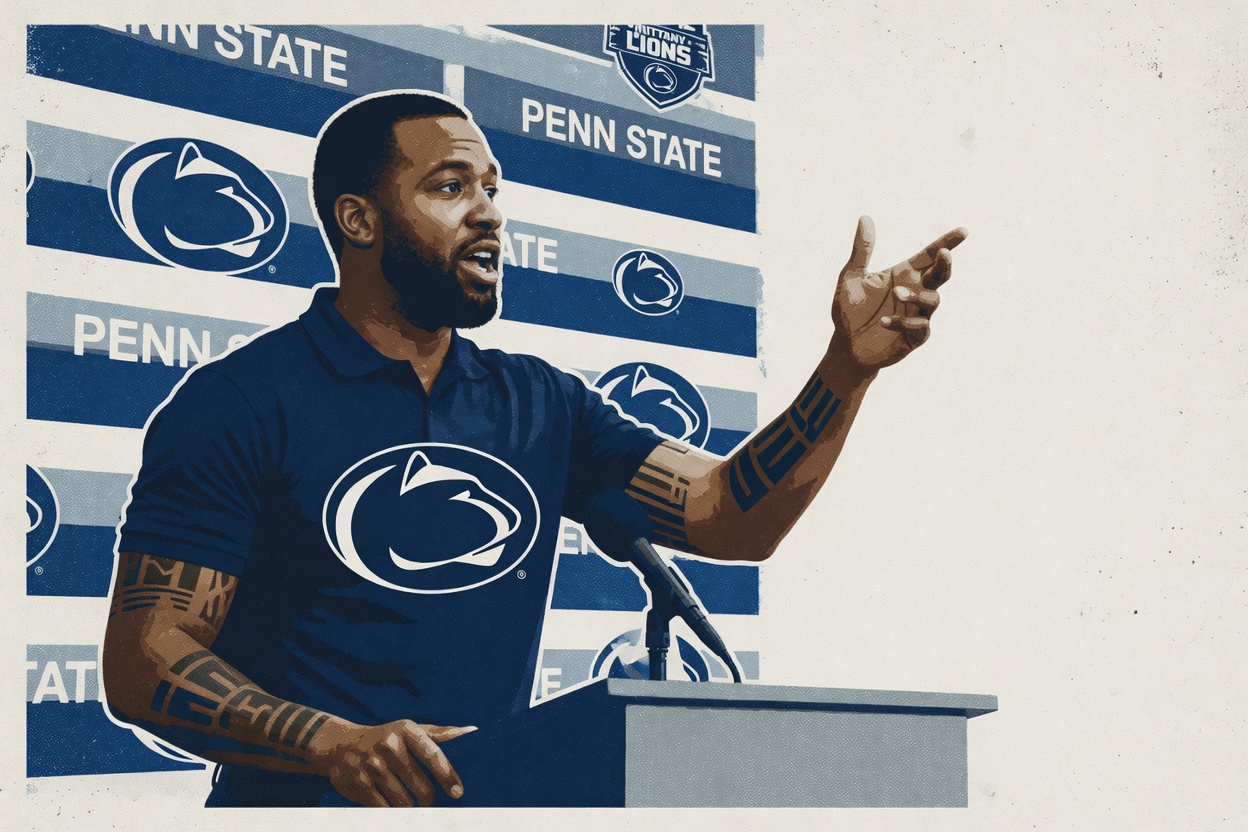
Assistant coach Jordan Lucas, 33, was formally charged this week with two misdemeanor counts of driving under the influence tied to an August incident in State College. Police wrote in an affidavit of probable cause that his blood alcohol level was 0.236 percent, nearly three times Pennsylvania's legal limit of 0.08. These are charges, not convictions, and the preliminary hearing isn't until Oct. 21. But the affidavit's account isn't a gray area.
Officers arrived during the early morning hours of Sunday, Aug. 16, and found a black Chevy Traverse sitting in a crosswalk with its passenger-side tires flattened. Witnesses said the driver was unconscious. Lucas, later identified as the driver, didn't initially respond to officers and was found with his foot still on the gas pedal while the SUV was in park. When asked to step out for field sobriety testing, he allegedly had to be helped to the sidewalk because he couldn't keep his balance. Street camera footage reportedly showed the SUV swerving into a bus lane multiple times on the 100 block of East Beaver Avenue before it came to rest in that crosswalk. Beyond the two DUI counts, Lucas faces summary offenses for driving on a suspended license, driving an unregistered vehicle, and parking in a crosswalk.
That's what happened. Here's the school's entire public response, word for word: "We are aware of these charges and take this matter seriously. Coach Lucas remains with the program. As this is a legal matter, we cannot comment further." The statement came from an assistant athletic director for football communications. So far, no outlet has reported any suspension, reassignment, or other disciplinary step. Lucas's exact title even differs depending who you ask: some call him the assistant linebackers coach, others the assistant cornerbacks coach. Either way, he remains, in the program's words, with the program.
"We take this matter seriously" is doing a lot of work for a sentence that commits to nothing. Taking something seriously, in practice, usually means doing something: a pause, a step back while the facts get sorted. What Penn State offered instead was confirmation that nothing is happening, wrapped in the language of concern. You can hide behind "it's a legal matter" to avoid discussing details, sure. But keeping a coach in his job the same week the affidavit becomes public is itself a decision, and it's one the program made without explaining.
What sharpens the point is how differently Penn State has talked about this kind of trouble before. In September 2024, under then-coach James Franklin, defensive end Amin Vanover was charged with two misdemeanor DUI counts after testing positive for THC following an August traffic stop. The athletics department's statement then carried a very different tone: it said the alleged actions "do not reflect the values and standards of our program and will be addressed." Franklin, asked about internal punishment, said he didn't typically discuss such matters and pointed to the released statement. What discipline, if any, Vanover received was never made public, so I won't claim he was punished. But the words matter on their own.
Set the two statements side by side. A player's marijuana-related DUI got language about violating the program's "values and standards." A coach's alcohol DUI, charged with a blood alcohol level nearly triple the limit and an affidavit describing a man too impaired to stand, got "we take this matter seriously" and confirmation he keeps his job. That's my read, not an official Penn State position, and it deserves a real caveat: these statements came from two different administrations. The Vanover language belonged to the Franklin-era communications staff. The Lucas statement was issued under Matt Campbell's new regime, which retained Lucas, a Franklin-era hire, through the coaching transition. So these aren't the same decision-makers treating a player and a coach differently on the same afternoon. It's a program that, in the recent past, reached for sterner words about a player than it just used for a coach whose alleged conduct was, by the numbers, more severe.
That gap is worth sitting with, because the usual justifications run the other way. Players are young, often teenagers or barely out of their teens, learning to make adult decisions in public. Coaches are the adults hired to model the standard. Lucas played defensive back at Penn State from 2012 to 2015 and had a six-year NFL run that included a Super Bowl win with the Chiefs before joining the staff in 2024. He isn't a kid finding his footing. If a program is going to invoke "values and standards" for a 20-year-old, the least it owes its audience is a consistent posture when the person charged is on the payroll to enforce those values.
None of this presumes guilt. Lucas is entitled to his day in court, and Oct. 21 is the next concrete date on the calendar. Campbell's staff is new, still being judged on everything, and "we can't comment on a legal matter" is a defensible legal instinct. But there's a difference between not commenting and not acting, and Penn State has, so far, chosen both. The program is welcome to prove the skeptics wrong when the hearing arrives and the picture sharpens. Until then, two sentences and a coach who "remains with the program" is what accountability looks like at Penn State right now. That's a thin answer to a thick set of allegations.