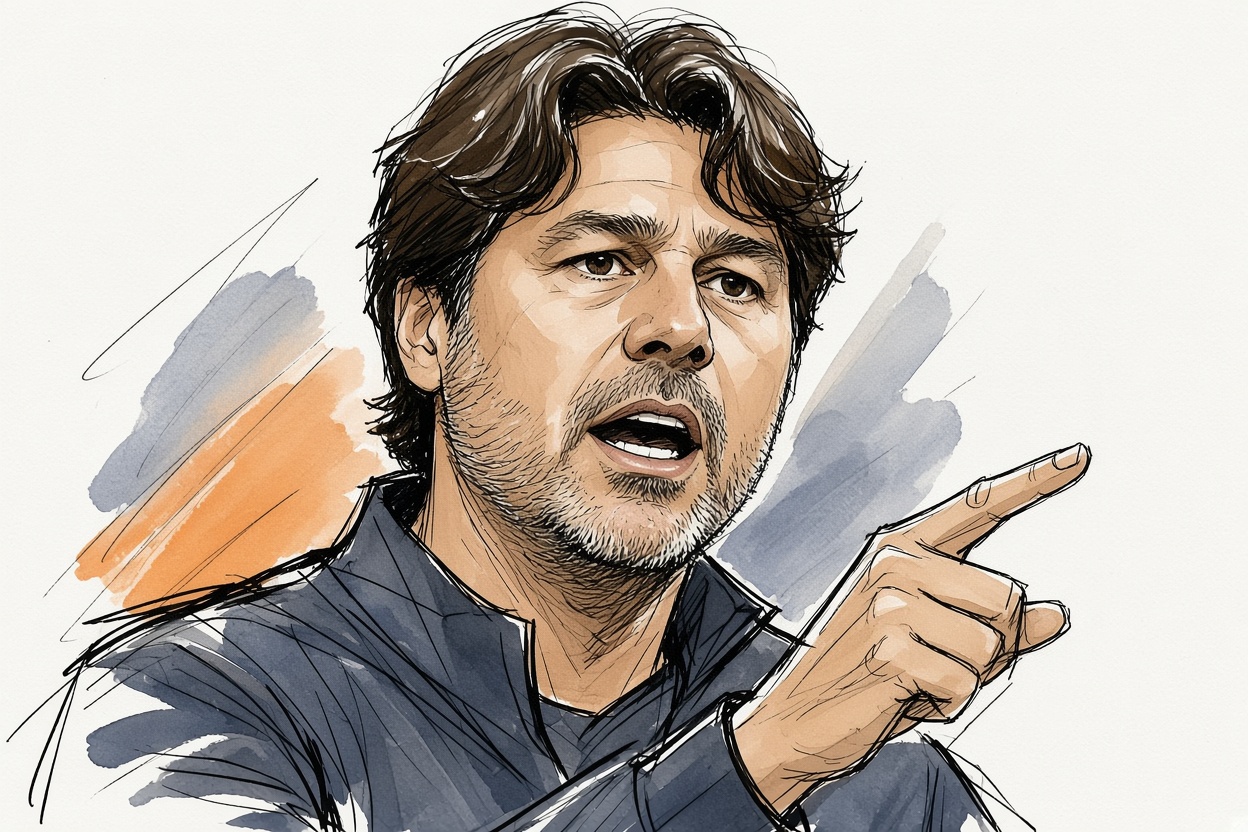
Mauricio Pochettino walked out of the USMNT job this week pointing at the easiest villain in American soccer: a league that doesn't punish failure, so players who grow up in it never learn to fear it. He's half right. The half he got wrong lets the exact people who hired him off the hook.
He said it out loud, in an interview with El Pais timed right before the U.S. opened its World Cup with a 4-1 win over Paraguay, so the whole world was watching when it landed. "If you start in MLS and you haven't won a game in three months and you're at the bottom, what's the consequence if there's no promotion or relegation, no international competition? American sports reward losers! If I lose, what happens? Nothing. They just fire the coach." Then the knife twist: "Also, the American player is disciplined. But with a sense of complacency that isn't good in soccer. It took us a year and a half to change that mentality."
The mechanics of his gripe check out. In MLS, the team that finishes bottom gets the highest draft pick as a reward. In Europe, the team that finishes bottom drops a division. That's a different relationship to a losing streak, and across American sport the parity machine is the whole design: the NBA has crowned eight different champions in eight straight years, with zero repeats. Spread the spoils and keep every market close enough to sell a season. If you've spent your life inside Premier League relegation terror, the softness of that is going to look like a disease.
Relegation anxiety at the top of MLS wouldn't do anything for a 14-year-old whose family can't afford the travel fees to get seen in the first place. That's the actual bottleneck, and it sits miles upstream of the first team: a pay-to-play youth system that sorts kids by household income before it sorts them by ability, patchy scouting below a handful of good academies, and a closed league built to grow franchise values instead of applying competitive pressure anywhere in the pyramid. Pulisic, McKennie, Musah: that's a serious generation, and it didn't struggle because MLS has a safety net. Most of the country's best teenagers leave for Europe long before they'd ever feel an MLS floor under their feet.
American soccer isn't actually pro/rel-free. The USL built its own system across the Championship, League One and League Two. It just doesn't connect to MLS, so the top flight stays sealed off from the one consequence Pochettino says is missing. The honest word is insulated. He picked rewards losers because that line plays well on the way out to Manchester United.
Pro/rel wouldn't have made American players better, either. Europe's flagship leagues let a small cluster of rich clubs hoard the trophies decade after decade while the money hardens at the top. The trapdoor punishes the bottom and does nothing to crack open the summit. Player development runs on access. The U.S. model chokes that off.
The blame belongs with U.S. Soccer and MLS ownership, who built and still run a development pyramid that charges admission to the kids who can't pay and shrugs at the ones who can't be found. That's the federation Pochettino worked for, and it's a lot less convenient to say on the way out than "American sports reward losers."
He earned some credit. By most accounts inside the camp he did rewire the mentality he inherited, and complacency in that player pool was real. But the same week gave us the other read: a coach who talked up the Premier League more than he loved this job, one foot already out the door he's now walked through. Both things are true about him. And the part he was loudest about on the way out is the part that matters least. He named a trapdoor nobody important falls through, and said nothing about the gate that keeps half the country's kids off the field.