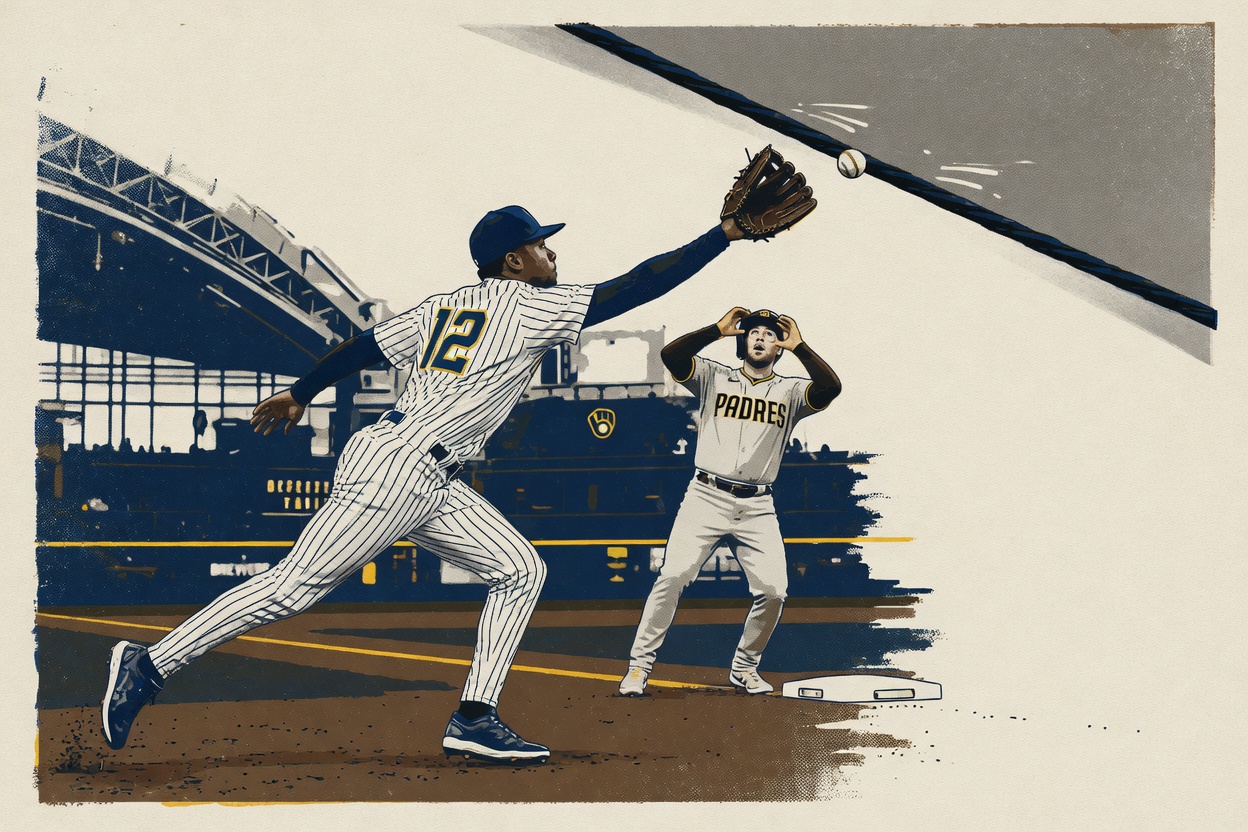
Stop yelling at the umpires. They got the Ty France flyout exactly right, and the fact that they got it right is the whole problem.
This is what happened in Game 1 of the NLDS on Saturday. Brewers up a run, one out in the ninth, tying run aboard, closer Trevor Megill on the mound. France turned on a 1-0 fastball and hit it 105.3 mph at a 49-degree launch angle. The ball climbed into the roof of American Family Field, struck a cable over fair territory, and dropped into Jackson Chourio's glove at the left field warning track, 325 feet from home plate. Under the park's posted ground rules, a batted ball that hits the roof, truss, or cable over fair territory is live, and if a fielder catches it, the batter is out. The umpires agreed the contact was over fair territory. Craig Stammen challenged, and the challenge failed. Milwaukee won 3-2 and took a 1-0 lead in the best-of-five.
Every piece of that is mechanically correct. The rule is posted, the review backed it, and ground rules apply to both dugouts the same way. If you want to be mad at the three-man booth that kept insisting the ball was clearly gone, be mad: "That ball's a home run," A.J. Pierzynski said, before admitting in the same breath, "If it would've stayed fair. We don't know if it would've stayed fair." Adam Wainwright kept repeating "I think that was a homer" like saying it twice made it true. That's the controversy they manufactured. Nobody can tell you where a ball that got eaten by a wire 325 feet out was going to land.
The physics don't rescue the Padres either. Statcast's estimate had that ball leaving only one major league park, Daikin Park in Houston. A batted ball at 105 mph and 49 degrees has never been a home run in the tracked era. There's never been a homer over the fence at American Family Field at a launch angle above 46 degrees since tracking began in 2015. The honest answer is probably not, and we'll never know, because a piece of stadium hardware got there first.
The anger belongs on the sport that hung a cable directly in the cone of a deep fly ball and left it there. Chourio said he thought he had a play on it off the bat. France hit it as hard as a human can hit a baseball at that angle. The crew read the rulebook and applied it correctly. None of them did anything wrong.
The strongest counter treats a ball that hits a roof or railing above the field the same way as a ball that hits a wall: the trajectory decides it. I agree with that instinct, and it only sharpens the indictment. Baseball tracks exit velocity and launch angle to the tenth of a degree in real time and puts it on screen within seconds. A sport with that technology has no business letting a half-century-old engineering compromise decide the biggest at-bat of a playoff night by pure chance. Either net those structures off entirely and make the contact a dead ball, the way foul territory already works, or use the trajectory data MLB already collects to figure out what would have happened. Pick one.
The Padres also stranded 12 runners and went 1-for-9 with men in scoring position, and Jackson Merrill came up with the bases loaded and couldn't cash it. A team that leaves a dozen men on doesn't get to pin a loss on the ceiling. San Diego beat itself long before the ninth inning, and it entered this series having won 19 of its last 22. The France flyout didn't cost them the game.
But the two things live together. The lineup blew its own chances, and the sport let a coin flip decide a playoff game and called it due process. Milwaukee just got lucky: their roof swallowed a scorching line drive. The people who should feel sheepish this morning are the ones who built a dome with wire strung across the flight path of a routine deep fly and never fixed it. The umpires did their job. MLB's refusal to do its own is the scandal.