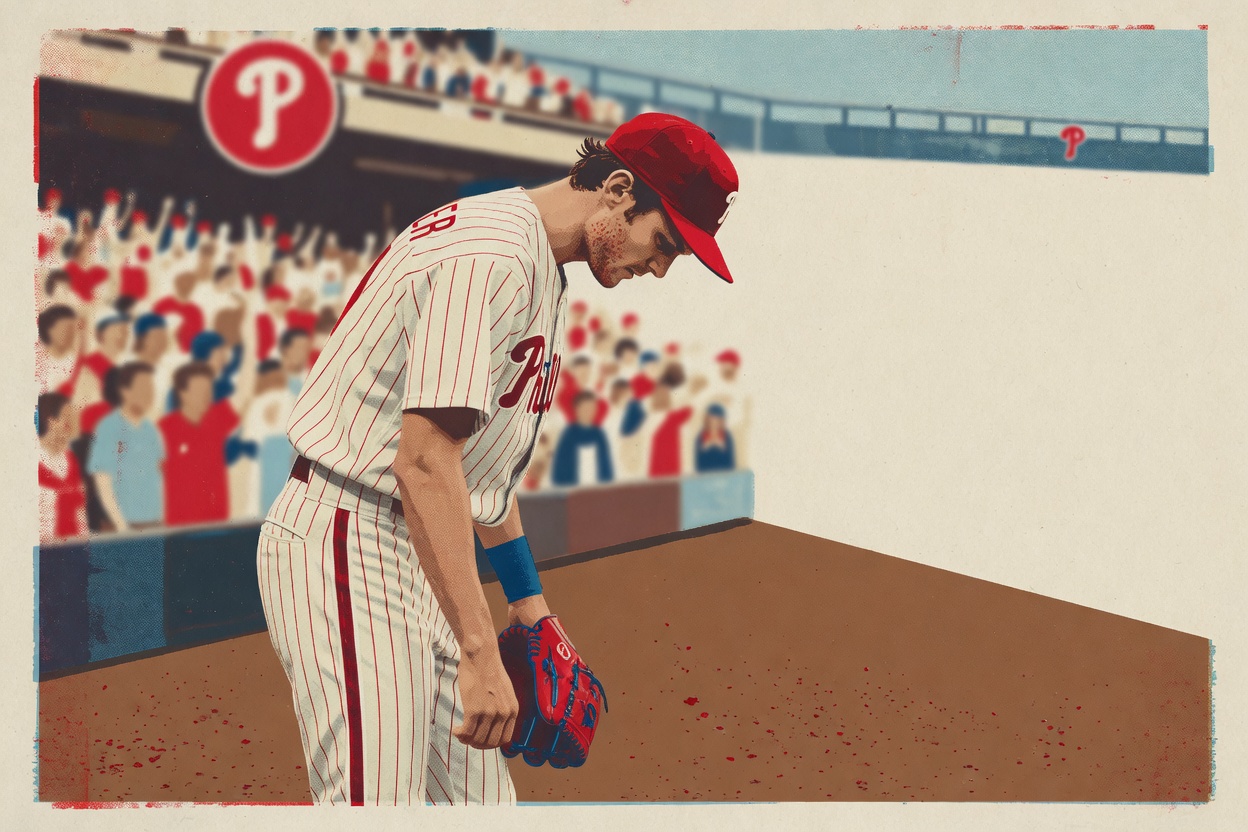
Everyone wants to turn the Phillies' payroll into a horror story. Close to $400 million still owed to three guys who are all 33 and watching another season end without a ring. Easy villain, tidy headline. It's also mostly wrong.
Two of those three deals are fine. One of them is the problem. And neither the good deals nor the bad one is the actual reason this team keeps losing in October.
Start with the one that stings. Trea Turner, signed to an 11-year, $300 million contract back in December 2022 and locked in through 2033 at $27.2 million a year, just put up the kind of season that makes a fan base sick. He hit .242 with 19 home runs, 58 RBIs and a .675 OPS across 157 games, a real drop from 2025 when he slashed .304 with an .812 OPS. Then the postseason arrived and he went 1-for-10, a .100 average with a .382 OPS. He wasn't saving it with the glove either: he led the majors with 21 errors, to go with a minus-15 defensive runs saved and minus-7 outs above average. It's a premium shortstop contract paying for subtraction on both sides of the ball. Turner didn't hide from it. "A lot of that is on me," he said, which is more accountability than most players owned after this one.
Now the part the pile-on conveniently skips. Bryce Harper, owed money through 2031 at $23.5 million a year off the original 13-year, $330 million deal he signed in March 2019, actually had a bounce-back year. He slashed .269/.380/.485 with 29 home runs and 87 RBIs, and he played all 162 games for the first time in his career. He faded in September, sure. He's also still one of the best hitters in the building, and you don't cut a check that size and then whine when the guy is still good.
Kyle Schwarber is the easiest call of the three. He re-signed for five years and $150 million last December, with four years and $132 million left, and he's done nothing but hit, leading the majors in home runs over the past five seasons. If you're clutching your chest over that one, you're asking for stars at discount prices.
The "$384 million burden" crowd has it backwards. You pay for proven production and accept that some of it decays on the back end. That's the deal, every time, for every franchise that actually tries to win. Signing great players to long contracts is standard business. Turner's deal went bad. The other two didn't.
What the Phillies don't have is anywhere to turn when a $27 million player craters. The farm system sits in the mid-to-high 20s, 26th in MLB Pipeline's latest rankings. The failure is the absence of young, cheap talent behind it, nothing to absorb a bad year or push out a fading veteran. A top-heavy roster with an empty cupboard underneath is a front-office problem, and it belongs to the people who keep running the same core back into October and watch it get eliminated before the NLDS for a fourth straight year. Second in the NL East at 88-74 is a good team with a ceiling it keeps bumping its head on.
Turner could bounce back. His track record says it's possible, and his contract runs long enough that one ugly season doesn't have to define it. But even if he never finds it again, blaming the Phillies' October rut on three contracts is lazy. Pay your stars. That part they got mostly right. The sin is building a juggernaut at the top and leaving nothing underneath it, and no amount of yelling at Trea Turner fixes that.